
Urinary Retention Risk Calculator
How to Use This Calculator
This tool estimates your risk of urinary retention from anticholinergic medications based on factors discussed in the article. It's not a substitute for medical advice.
Your Risk Assessment
URGENCY: STOP MEDICATION AND SEE A DOCTOR IMMEDIATELY
Urinary retention is a medical emergency. Call your doctor or go to the emergency room now.
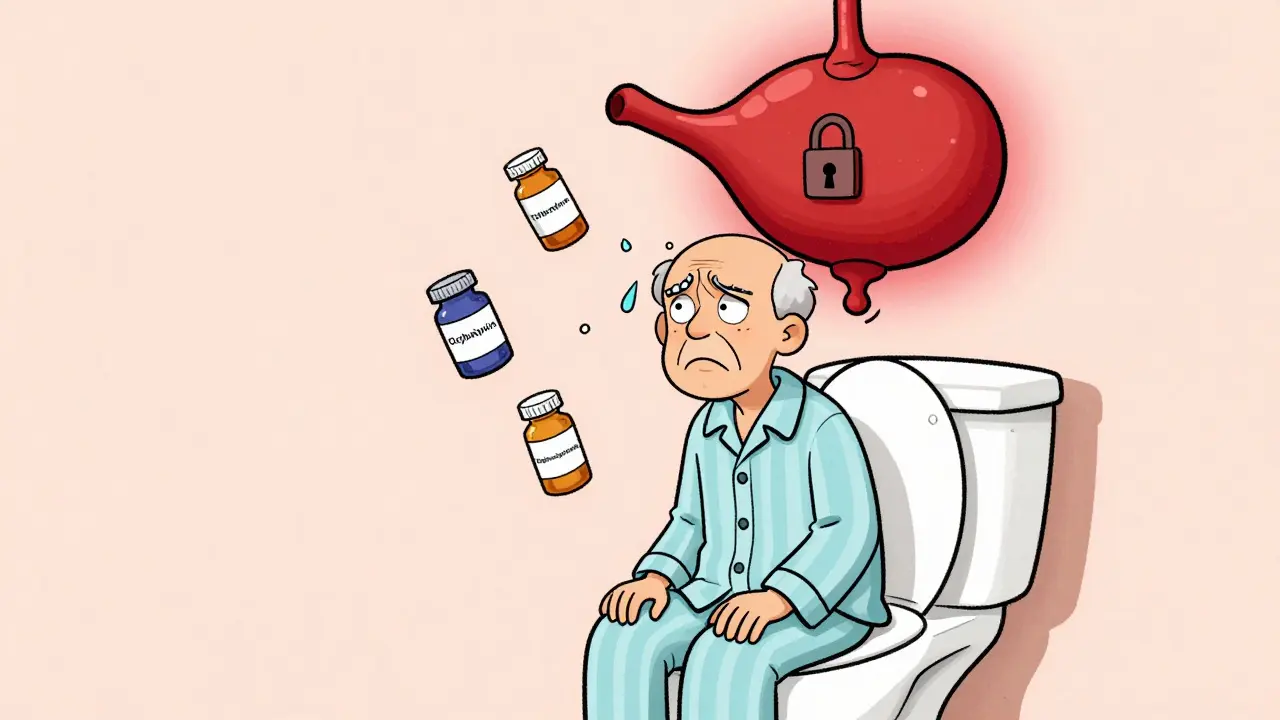
It’s not something people talk about much, but anticholinergic drugs can silently shut down your ability to urinate. For many, especially men over 65, what starts as a simple prescription for overactive bladder can lead to a medical emergency-complete inability to pee, pain, and urgent catheterization. This isn’t rare. It happens more often than most doctors admit.
How Anticholinergics Break Your Bladder’s Signal
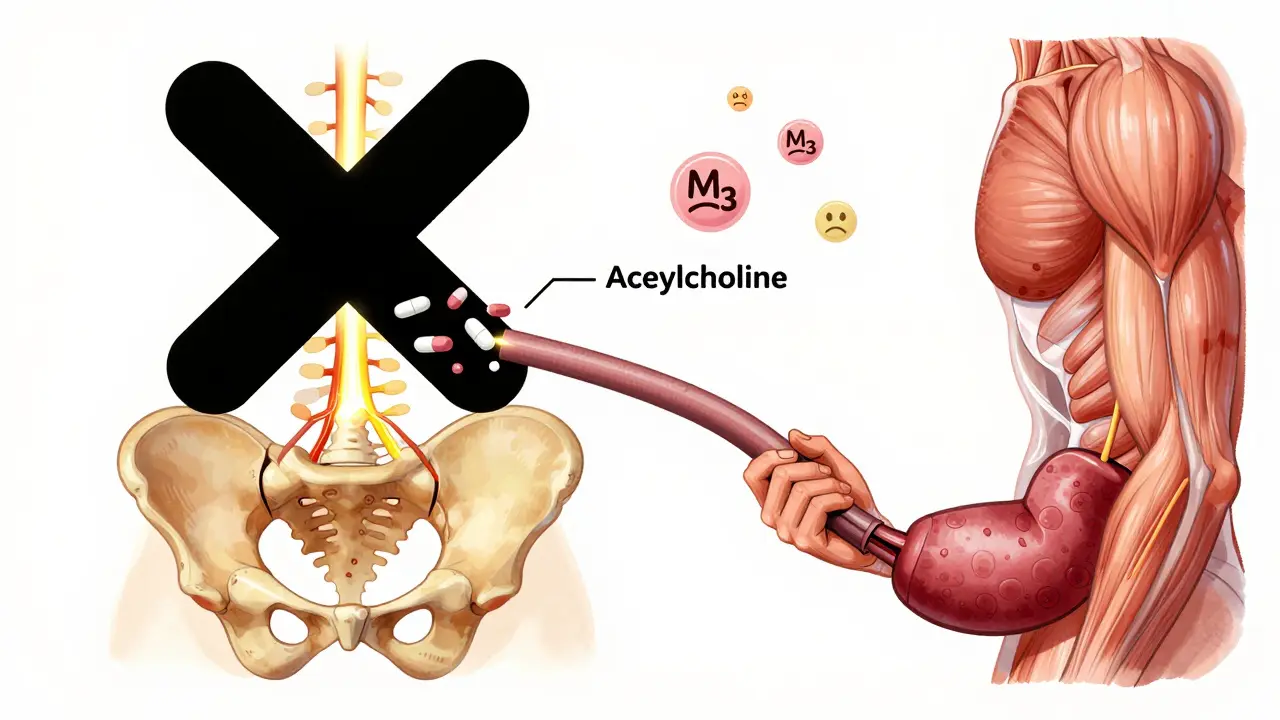
Your bladder doesn’t just fill up and empty on its own. It’s controlled by nerves that use a chemical called acetylcholine to tell the detrusor muscle (the main bladder muscle) to contract and push urine out. Anticholinergic drugs block this signal. They bind to muscarinic receptors, especially the M3 type, which is the one that actually triggers the squeeze. Without that signal, the muscle stays relaxed. The bladder fills, but nothing happens when you try to go.
It’s not just about the drug-it’s about your body. Men with even mild prostate enlargement are at much higher risk. The prostate already squeezes the urethra. Add a drug that stops the bladder from pushing hard enough, and you’ve got a perfect storm. Studies show that in men over 65 with enlarged prostates, the risk of drug-induced retention jumps from 0.5% to over 4%. That’s one in 25 men. And it can happen fast-within days of starting the medication.
Not All Anticholinergics Are the Same
Just because a drug is in the anticholinergic class doesn’t mean it’s equally risky. The difference matters a lot.
- Oxybutynin is the classic one. It hits M1, M2, and M3 receptors hard. It’s cheap, widely prescribed, and carries the highest risk-up to 2.5% of men with prostate issues develop retention on it.
- Tolterodine is slightly safer, with about half the risk of oxybutynin in head-to-head studies.
- Solifenacin is more selective for M3, so it’s a bit gentler on the bladder. But even then, 1.2-1.8% of high-risk men still end up unable to pee.
- Trospium chloride doesn’t cross the blood-brain barrier as easily, which means fewer brain side effects like confusion, but it still blocks bladder receptors and carries moderate-to-high risk.
- Darifenacin is the most selective for M3, making it the safest option in this group-but it’s still not risk-free.
There’s also a scoring system called the Anticholinergic Cognitive Burden (ACB) scale. Drugs like oxybutynin and diphenhydramine score a 3-the highest. People taking multiple drugs with ACB scores of 3 or higher have a 68% higher chance of urinary retention. If you’re on three or four medications, even if each seems harmless alone, the pile-up can be dangerous.
Who’s Most at Risk?
You’re at higher risk if you:
- Are male and over 65
- Have an enlarged prostate (BPH)
- Already have trouble starting your stream or feel like you never fully empty
- Take other drugs that slow bladder function-like opioids, tricyclic antidepressants, or muscle relaxants
- Have dementia or cognitive decline
- Are on multiple medications (polypharmacy)
Women can get retention too, but it’s far less common-about 5% of women on these drugs report issues, versus over 12% in men. Why? Because men’s anatomy makes them more vulnerable. The prostate adds physical blockage. The bladder muscle has to work harder just to get urine out. When you add a drug that weakens that muscle, the system fails.
Real Stories, Real Consequences
On Drugs.com, a 68-year-old man named JohnM72 wrote: “After two weeks on oxybutynin, I couldn’t pee at all. I ended up in the ER with a catheter. My urologist said this happens in 1 out of 50 men like me.”
On Reddit’s r/urology, over 120 posts since 2020 describe similar emergencies. One man, 71, had to be catheterized after taking tolterodine. Another, 74, waited three days before going to the hospital because he thought it was “just getting worse.” He ended up with a bladder infection and kidney stress.
A 2022 survey of 1,234 people on anticholinergics found that 8.7% had to be catheterized because they couldn’t pee. Most of those cases happened within the first 30 days. Only a small number had their doctors check their post-void residual (PVR) before or after starting the drug.
What Doctors Should Do-But Often Don’t
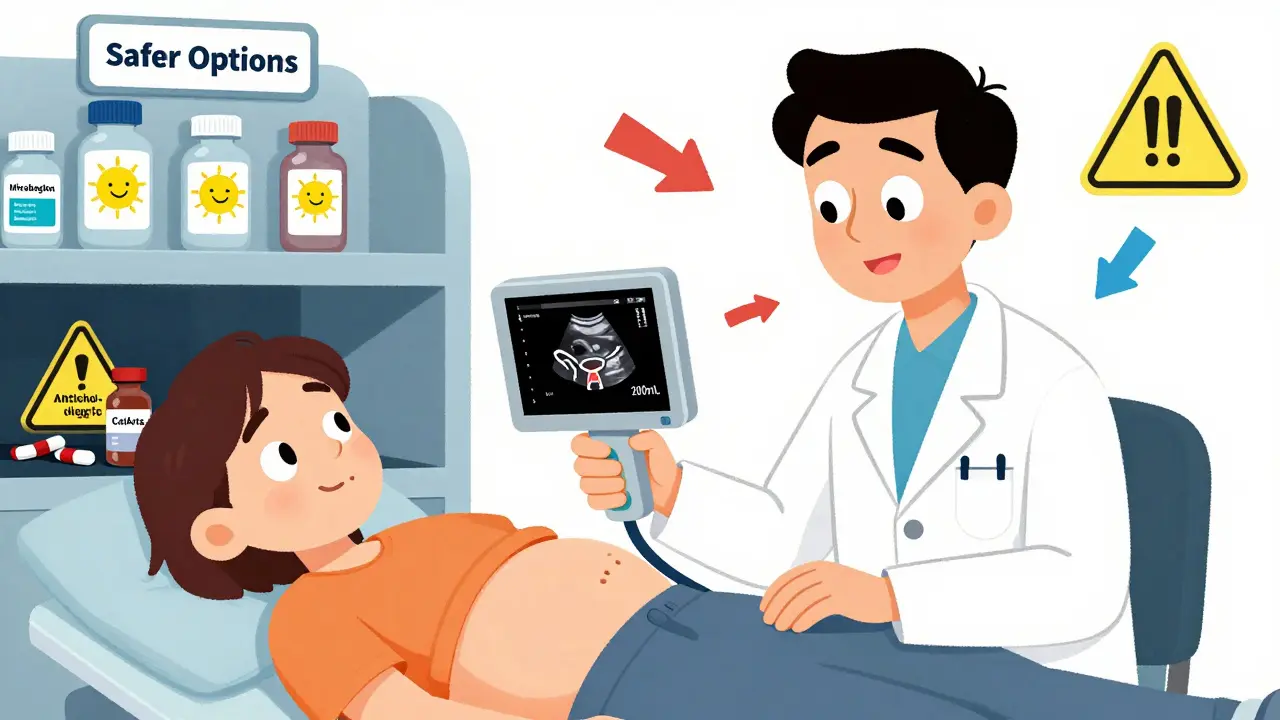
The American Urological Association (AUA) says this clearly: Measure your PVR before starting anticholinergics in men. PVR means checking how much urine is left in the bladder after you go. If it’s over 150 mL, you shouldn’t be on these drugs. Period.
But most primary care doctors don’t have bladder scanners. They don’t know how to use them. And they rarely refer patients to urologists before prescribing. So patients start the drug, feel a little better, and never get checked.
Even worse, many patients don’t know what to watch for. The warning signs are simple:
- Straining to start peeing
- Weak or slow stream
- Feeling like you’re not done after you go
- Needing to go again 15 minutes later
- Abdominal pain or bloating
- Not peeing for 12+ hours
If you have any of these and are on an anticholinergic, stop the drug and call your doctor immediately. Don’t wait.
Better Options Exist
There are safer alternatives-and they’re not just for last resort.
- Mirabegron (Myrbetriq) works differently. Instead of blocking signals, it activates beta-3 receptors to relax the bladder muscle. It’s just as effective for overactive bladder, but the retention risk is only 0.3%-about 5 times lower than anticholinergics.
- OnabotulinumtoxinA (Botox) injections into the bladder wall are highly effective and carry only a 0.5% retention risk. It’s not for everyone-it requires a specialist and a minor procedure-but for men with BPH and OAB, it’s often the best choice.
- Alpha-blockers like tamsulosin help relax the prostate and urethra. When combined with a low-dose anticholinergic, they can reduce retention risk by 37%. But even then, it’s not ideal.
- Transdermal oxybutynin (the patch) has 42% less retention risk than the pill. It’s slower to absorb, so it doesn’t flood your system.
Market trends are shifting. In 2015, anticholinergics made up 58% of overactive bladder prescriptions. By 2022, that dropped to 39%. Mirabegron now holds 31% of the market. Why? Because doctors are learning the hard way that the risks often outweigh the benefits-especially in men.
The Bottom Line
If you’re a man over 65 with prostate issues, anticholinergics are not your first-line treatment. They’re a last-resort option, if at all. The FDA now requires black box warnings on all these drugs for urinary retention risk. The European Medicines Agency says they’re contraindicated if you’ve ever had retention. The American Geriatrics Society says they’re potentially inappropriate for older adults.
Ask your doctor: “Have you checked my post-void residual?” If they say no, ask why. If they say you’re fine because you “don’t feel blocked,” push back. Feeling fine doesn’t mean your bladder is emptying. You can have 200 mL left in there and feel nothing.
And if you’ve been on one of these drugs for more than a month without a PVR check, get one. Now. It takes five minutes. A simple ultrasound scan. No needles. No pain. It could save you from an emergency room visit, a catheter, and weeks of discomfort.
There’s no shame in switching. There’s no pride in sticking with a drug that might stop you from peeing. Safer options are out there. Use them.



Joanna Brancewicz
Anticholinergics are a classic case of pharmacological overreach. M3 receptor blockade = bladder paralysis. Simple neuropharmacology. But the real issue? Clinicians treat symptoms, not systems. PVR should be mandatory pre-prescription-period. No excuse.