

When a pharmacist hands you a pill bottle with a different name than what your doctor wrote on the prescription, you might wonder: is this really the same thing? It’s not just a label swap. It’s a carefully regulated process built on science, law, and decades of clinical evidence. Pharmacists don’t guess. They don’t rely on gut feeling. They use a standardized, legally binding system to confirm that a generic drug is as safe and effective as the brand-name version - and that system starts with one document: the FDA’s Approved Drug Products with Therapeutic Equivalence Evaluations, better known as the Orange Book.
The Orange Book: The Bible of Generic Equivalence
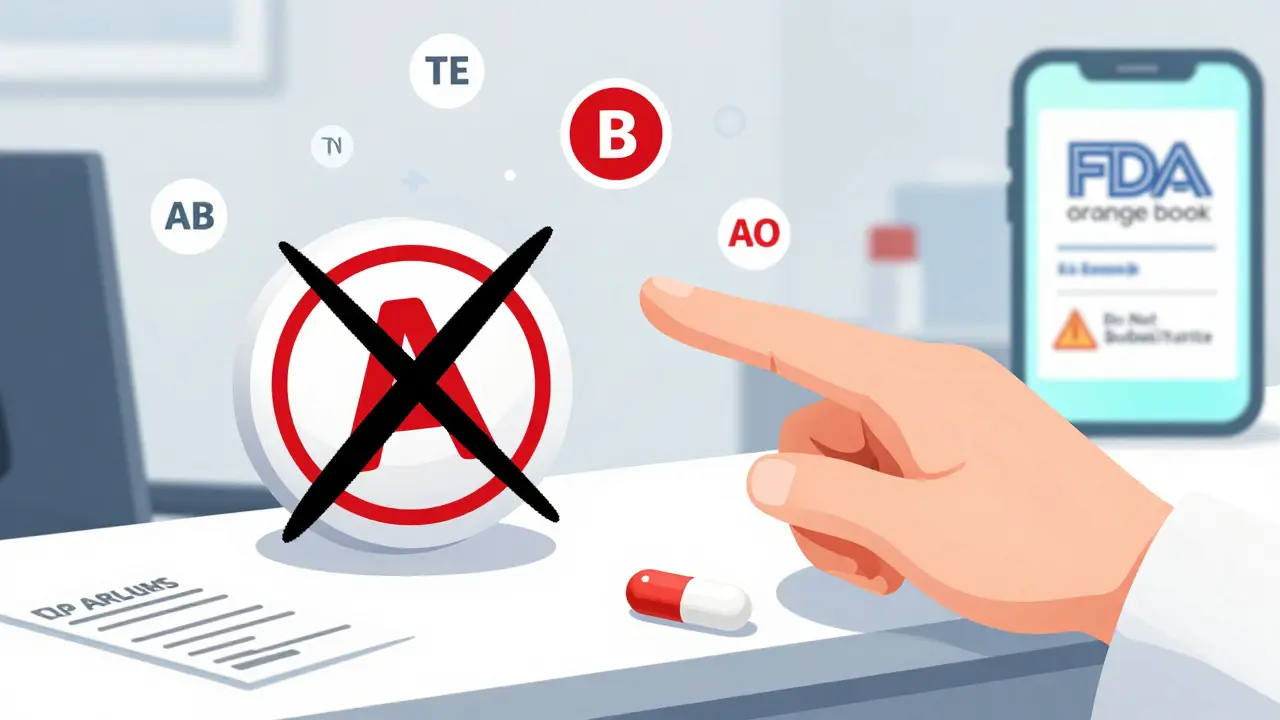
The Orange Book isn’t just a reference. It’s the legal foundation for generic drug substitution in every U.S. state. First published in 1980, it’s updated monthly and contains data on over 16,500 drug products as of April 2024. Each entry links a brand-name drug to its approved generic equivalents. But it doesn’t stop there. The real power lies in its therapeutic equivalence (TE) ratings, a two-letter code that tells pharmacists exactly what they can substitute.
Here’s how it works: if a generic drug gets an AB rating, it means it’s been proven to have the same active ingredient, strength, dosage form, and route of administration as the brand - and, more importantly, it’s been shown through human studies to deliver the same amount of drug into your bloodstream at the same rate. That’s bioequivalence. And if it’s rated AB? You can swap it with confidence. Over 98.7% of all rated products in the Orange Book carry this designation.
Other codes exist - like AN for nasal sprays, AO for oral liquids, or AT for topical creams - but they all follow the same logic: they tell you whether the product has been tested and approved under the same strict standards. Pharmacists don’t need to interpret. They just need to check the code.
What Makes a Generic “Equivalent”? Three Rules
Verifying equivalence isn’t about matching packaging or color. It’s about three precise criteria:
- Pharmaceutical equivalence: Same active ingredient, same strength, same form (pill, injection, inhaler), same route (oral, topical, etc.).
- Bioequivalence: The generic must deliver the drug into your bloodstream within a scientifically accepted range - specifically, 80% to 125% of the brand’s performance. This isn’t a guess. It’s based on statistical analysis of blood concentration data from clinical studies.
- Therapeutic equivalence: The final verdict. If the first two are met, and the FDA confirms no clinical differences exist, the product gets an “A” rating. That means substitution won’t change your outcome.
For most drugs, this system works perfectly. But for some - like warfarin, levothyroxine, or certain seizure medications - the margin for error is razor-thin. That’s why the FDA sometimes tightens the bioequivalence window to 90-111% for these narrow therapeutic index drugs. Pharmacists are trained to spot these and double-check.
How Pharmacists Actually Do It - Step by Step
At the counter, this isn’t a long process. It’s built into workflow. Here’s what happens when a prescription for Brand X comes in:
- Identify the reference drug: The pharmacist pulls up the brand name in their system and matches it to the Orange Book’s Reference Listed Drug (RLD) entry.
- Check active ingredients: They confirm the generic’s label matches the RLD exactly - no extra fillers, no missing components.
- Verify the TE code: They look for an “A” rating. If it’s “B,” they stop. No substitution. Ever.
- Confirm no “Do Not Substitute” flags: Even if the generic is rated AB, if the prescriber wrote “dispense as written,” the pharmacist must honor that.
This whole check takes 8 to 12 seconds. Most pharmacists use the free FDA Orange Book mobile app - downloaded over 450,000 times by March 2024 - or integrate it directly into their pharmacy software like PioneerRx or QS/1. In 98.7% of community pharmacies, this check happens daily.
Why Not Just Use Other Databases?
You might see commercial databases like Micromedex or Lexicomp on pharmacy screens. They’re useful. But they’re not the law. A 2021 study in the Journal of the American Pharmacists Association found that 99.3% of pharmacists use the Orange Book as their primary source. Only 62.7% use commercial tools as backups.
Why? Because the Orange Book is the only one with legal standing. In 2019, a Texas pharmacist was sanctioned after substituting a generic not listed in the Orange Book. The court ruled: if it’s not in the Orange Book, you can’t assume equivalence. Even if other sources say it’s fine. The law is clear: the Orange Book is the standard.
What About Complex Drugs? Inhalers, Creams, Injectables?
Not all drugs are pills. What about an asthma inhaler? A topical steroid? A long-acting injection? These are harder to test. Traditional blood-level measurements don’t always reflect how well the drug works in the lungs or skin.
The FDA acknowledges this. As of Q2 2024, it has issued product-specific guidance for 1,850 complex generics. These include detailed requirements - like particle size analysis for inhalers or skin absorption studies for creams - to ensure equivalence beyond just blood levels.
Pharmacists are trained to flag these. If a generic isn’t listed in the Orange Book with a clear TE code, they don’t substitute. They call the prescriber. They consult the FDA’s Non-Orange Book Listed Drugs framework. It’s not common - only 5.7% of substitutions fall into this gray zone - but when it does, pharmacists slow down. They don’t guess.
The Numbers Don’t Lie
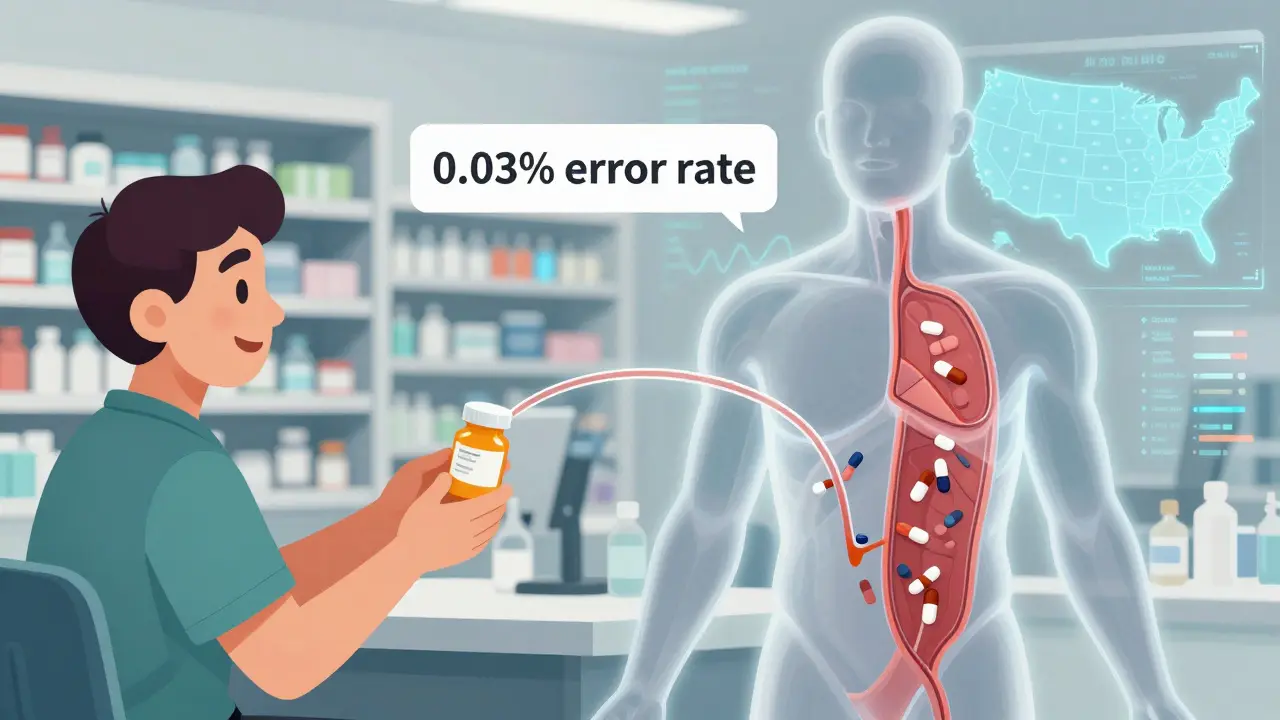
Generic drugs now make up 90.7% of all prescriptions filled in the U.S. - over 8.9 billion in 2023. And yet, substitution errors are incredibly rare. A 2023 study by the American Society of Health-System Pharmacists found a substitution error rate of just 0.03% when pharmacists follow the Orange Book protocol.
Even more telling: the FDA’s 2020 meta-analysis of over 2,000 studies found no meaningful difference in adverse events between brand and generic drugs - 0.78% for brands, 0.81% for generics. That’s not noise. That’s equivalence.
But the system isn’t perfect. Critics point out that biosimilars - the next wave of biologic generics - aren’t yet fully integrated. As of June 2024, only 47 of 350 approved biosimilars are listed in the FDA’s Purple Book, the biologics equivalent of the Orange Book. Pharmacists are preparing. Training is expanding. The same principles - verification, documentation, legal standards - are being adapted.
Training and Accountability
Nearly all pharmacies require new hires to complete 2-4 hours of formal training on the Orange Book. After training, competency tests show 89.3% accuracy in equivalence verification. That’s not luck. It’s repetition. It’s policy. It’s culture.
And when mistakes happen? They’re not just clinical errors - they’re legal risks. Pharmacists who skip the Orange Book, rely on unofficial sources, or assume equivalence without proof open themselves to malpractice claims. The system exists to protect patients - and pharmacists.
The Bigger Picture
This isn’t just about saving money. It’s about access. Generic drugs save the U.S. healthcare system over $12.7 billion every year. But without trust in equivalence, that savings vanishes. Patients won’t take them. Prescribers won’t prescribe them.
The Orange Book system, built on science, law, and transparency, is what makes that trust possible. It’s not flashy. It’s not glamorous. But every time a pharmacist checks that TE code, they’re upholding a standard that keeps millions of people safe - and the system affordable.
What does an 'A' rating mean in the Orange Book?
An 'A' rating means the generic drug is therapeutically equivalent to the brand-name drug. It has been proven to have the same active ingredient, strength, dosage form, and route of administration, and has passed bioequivalence testing showing it delivers the drug into the bloodstream at the same rate and extent. This rating allows pharmacists to legally substitute it without needing prescriber approval.
Can a pharmacist substitute a generic without the prescriber’s permission?
Yes - but only if three conditions are met: the generic is rated 'A' in the Orange Book, the prescription doesn’t have a 'dispense as written' or 'no substitution' note, and state law permits automatic substitution. All 50 U.S. states allow substitution unless the prescriber explicitly forbids it. Massachusetts is the only state that requires explicit patient consent before substitution.
Are all generics listed in the Orange Book?
No. Only generics that have been reviewed and approved by the FDA under an Abbreviated New Drug Application (ANDA) are listed. New generics can take months to appear. If a product isn’t listed, pharmacists cannot legally substitute it unless they follow the FDA’s 'Non-Orange Book Listed Drugs' guidelines, which require direct consultation with the prescriber and documentation of clinical justification.
Why do some generics have different colors or shapes than the brand?
U.S. law requires generic drugs to look different from the brand to avoid trademark infringement. The active ingredient, strength, and effectiveness are identical - but the inactive ingredients (fillers, dyes, coatings) can differ. This doesn’t affect performance. Pharmacists verify equivalence through the Orange Book, not appearance.
Is bioequivalence testing the same for all types of drugs?
No. For pills, it’s usually based on blood levels (Cmax and AUC). For inhalers, nasal sprays, or topical creams, the FDA uses different methods - like lung deposition studies or skin absorption measurements. These are outlined in product-specific guidances. Pharmacists rely on the Orange Book’s TE code to know whether these complex products have met the required standards.



APRIL HARRINGTON
I used to think generics were just cheap knockoffs until my grandma started taking them for her blood pressure and didn't die. Turns out the system works. I'm not a fan of Big Pharma anyway so I'm all in on generics now. They saved us like $800 a month.