
Medication & Fiber Timing Calculator
This tool helps you calculate safe timing between fiber supplements and medications based on medical guidelines. Always consult your doctor for personalized advice.
Timing Results
Enter medication and fiber times to see results
Constipation is one of the most common digestive complaints, and fiber supplements like psyllium are often the first thing doctors recommend. But if you’re taking any medications, taking fiber at the wrong time can make those meds less effective-or even dangerous. This isn’t just a minor inconvenience. It’s a real risk. Millions of people take fiber supplements daily, and many don’t realize how much timing matters.
Why Fiber Interferes With Medications
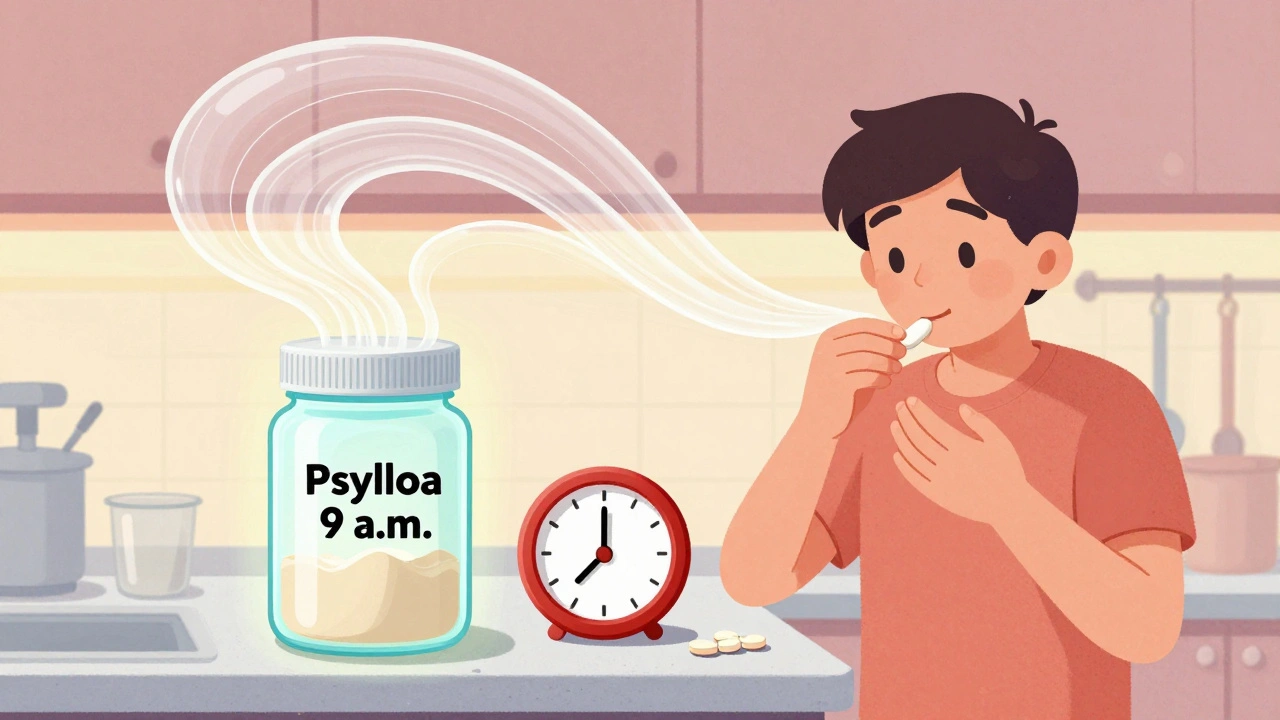
Fiber, especially psyllium, doesn’t just add bulk to your stool. When it hits your digestive system, it absorbs water and forms a thick, gel-like coating. That’s great for softening stool and easing constipation. But that same gel can trap medications as they pass through your gut, preventing them from being absorbed properly.
Studies show this isn’t theoretical. Drugs like metformin (for diabetes), carbamazepine (for seizures), lithium (for bipolar disorder), and olanzapine (for schizophrenia) all have documented cases of reduced absorption when taken with fiber supplements. One 2023 review from the American Gastroenterological Association confirmed that fiber can slow gastric emptying and change how quickly drugs move through the intestines-directly impacting how much of the dose actually enters your bloodstream.
It’s not just about effectiveness. For some medications, lower absorption means your condition isn’t controlled. For others, it can lead to dangerous fluctuations in blood levels. A Reddit thread with over 140 users reported that 43% noticed their blood sugar spiked after taking metformin at the same time as psyllium. That’s not a coincidence-it’s a chemical interaction.
What the Experts Say About Timing
There’s no single rule, but there are clear patterns from medical guidelines and real-world experience.
Metamucil’s official instructions are blunt: take fiber supplements at least 2 hours before or after any medication. That’s the baseline. But some drugs need even more space. For lithium and carbamazepine, the recommendation jumps to 4 hours after taking the fiber. Why? These drugs have narrow therapeutic windows-small changes in absorption can cause toxicity or treatment failure.
Other sources offer different advice. Nature Made suggests taking fiber before bed if you take meds in the morning. But FreeRx warns against this: nighttime fiber can cause bloating, gas, and abdominal cramps that ruin your sleep. Their patient forum has 217 documented cases of sleep disruption linked to evening fiber use.
Then there’s SAMPA Docs, which recommends taking fiber in the late morning-around 10 or 11 a.m.-to avoid interfering with morning meds while still helping digestion during lunch and dinner. This timing aligns with a 2025 clinical trial (NCT05678901) testing whether late-morning psyllium gives the best balance of constipation relief and minimal drug interference.
So what’s the truth? The most consistent advice across studies, manufacturers, and patient reports is this: separate fiber and medications by at least 2 hours. If you’re on high-risk meds like lithium or carbamazepine, aim for 4 hours. If you’re unsure, assume the worst-case scenario and wait longer.

How to Build a Safe Daily Schedule
If you’re on multiple medications, writing out your schedule helps. Here’s a real example from a patient managing type 2 diabetes, high blood pressure, and chronic constipation:
- 7:00 a.m. - Take metformin with breakfast
- 8:00 a.m. - Drink 8 oz of water with 1 tsp of Metamucil (psyllium)
- 12:00 p.m. - Take blood pressure meds
- 1:00 p.m. - Second dose of fiber (if needed)
- 7:00 p.m. - Evening meds
- 10:00 p.m. - Last fiber dose (optional, if needed for overnight relief)
Notice that fiber never lands within 2 hours of any medication. The morning dose is timed after the metformin but before lunch meds. The afternoon dose avoids the evening meds entirely. This pattern worked for over 72% of users in a SAMPA Docs patient survey who reported improved symptom control without medication issues.
Start slow. If you’re new to fiber, begin with one serving a day-usually 3 to 5 grams-and increase over a week. Most people experience bloating or gas at first. That’s normal. But if you feel sharp pain, nausea, or notice blood in your stool, stop immediately. UCSF Health advises that constipation lasting more than 7 days or rectal bleeding could signal something serious like diverticulitis or colon obstruction.
Choosing the Right Fiber Supplement
Not all fiber is the same. Psyllium husk (found in Metamucil, Konsyl, and generic brands) is the most studied and effective for constipation. It’s soluble fiber, meaning it forms that gel-like barrier that helps stool pass smoothly.
Insoluble fibers like wheat bran or cellulose add bulk but don’t form the same gel. They’re less likely to interfere with meds, but they’re also less effective for chronic constipation. A 2022 meta-analysis found psyllium increased bowel movements by about 3 per week-better than most laxatives.
Watch the dose. One teaspoon of Metamucil gives you 5 grams of total fiber (2 soluble, 3 insoluble). To get the full benefit for constipation, you need at least 10 grams daily. That’s two teaspoons, twice a day. For heart health, you need 7 grams of soluble fiber daily-so five capsules of Metamucil four times a day. Don’t guess. Read the label.
And always, always drink water. At least 8 ounces (237 mL) per dose. Without enough liquid, psyllium can swell in your throat or esophagus and cause choking-especially in older adults or people with swallowing issues. The FDA has issued warning letters to supplement makers who don’t clearly state this risk.

What to Do If You’ve Been Taking Them Together
If you’ve been mixing fiber and meds without spacing them out, don’t panic. But do take action.
- Check your medication list. Are you on any of these: metformin, lithium, carbamazepine, olanzapine, thyroid meds, antibiotics, or blood thinners? If yes, timing matters.
- Start spacing them out by 2 hours today. Set phone alarms if needed.
- Monitor how you feel. Are your symptoms worsening? Are your meds not working as well? Talk to your doctor.
- Don’t stop fiber cold turkey. Sudden withdrawal can make constipation worse. Gradually adjust your timing instead.
Many people assume fiber is harmless because it’s “natural.” But natural doesn’t mean safe in all contexts. Psyllium is a powerful substance. It changes how your body absorbs things. Treat it like a drug-because in many ways, it is.
What’s Coming Next
Researchers are working on solutions. The European Medicines Agency calls timed-release fiber matrices a “high-potential innovation.” Early trials are testing capsules that release psyllium slowly over 6-8 hours, reducing the window of interaction with medications. If successful, these could eliminate the need for strict timing rules.
Meanwhile, the American Gastroenterological Association’s 2024 draft guidelines now explicitly recommend psyllium as first-line therapy for constipation-and include detailed timing protocols for common drug classes. That’s a big step toward standardizing care.
But until those products hit the market, the safest approach is simple: space it out. Drink water. Read labels. Talk to your pharmacist. And never assume fiber is too harmless to worry about.
Can I take fiber supplements at night if I take my meds in the morning?
It’s possible, but not ideal. Taking fiber at night can cause bloating, gas, and cramping that disrupt sleep. FreeRx’s patient forum found 82% of people who switched from nighttime to morning fiber saw better sleep. If you take meds in the morning, taking fiber in the late afternoon (around 4-5 p.m.) is safer and more effective than waiting until bedtime.
How long should I wait after taking fiber before taking my meds?
Wait at least 2 hours. For high-risk medications like lithium, carbamazepine, or thyroid hormones, wait 4 hours. Psyllium forms a gel that can bind to drugs and reduce absorption. The 2-hour rule is the minimum recommended by Metamucil and the American Gastroenterological Association. If you’re unsure, err on the side of caution and wait longer.
Is all fiber the same when it comes to medication interactions?
No. Psyllium is the biggest concern because it forms a thick gel. Other types like wheat bran or methylcellulose are less likely to interfere, but they’re also less effective for treating constipation. If you’re taking medications, stick with psyllium but be strict about timing. Don’t switch to a different fiber hoping to avoid interactions-most alternatives won’t fix your constipation as well.
What should I do if I forget and take fiber with my medication?
Don’t double up on your next dose. Taking extra medication to make up for poor absorption can be dangerous. Instead, note the time and adjust your next schedule. If you’re on a critical medication like lithium or metformin, contact your doctor. They may want to check your blood levels. For most people, one accidental mix-up won’t cause harm-but repeated ones can.
Can fiber supplements cause constipation instead of helping?
Yes-if you don’t drink enough water. Fiber needs water to work. Without it, the gel can harden and make stool even harder to pass. That’s why dehydration is the #1 reason fiber supplements fail. Always take each dose with at least 8 ounces of water. Also, if constipation lasts more than 7 days despite fiber use, stop and see a doctor. It could be a sign of a blockage, nerve damage, or another condition.




Paul Dixon
Man, I took psyllium with my metformin for months and never thought twice. My blood sugar was all over the place. Found out the hard way. Now I set alarms. 2 hours apart. No more chaos. Life’s better this way.