
Naranjo Scale Causality Calculator
The Naranjo Scale is the most widely used tool to determine if a drug caused a patient's adverse reaction. It's a 10-question checklist that assigns points based on answers, leading to a final score that classifies the reaction as Definite, Probable, Possible, or Doubtful.
When a patient gets sick after taking a new medication, how do you know if the drug actually caused it? It’s not always obvious. Maybe it’s the infection they had, the other meds they’re on, or just bad luck. That’s where the Naranjo Scale comes in. Developed in 1981, it’s still the most used tool in hospitals and pharmacies around the world to figure out if a bad reaction was really caused by a drug - or if something else is to blame.
What Is the Naranjo Scale?
The Naranjo Scale isn’t magic. It’s a simple 10-question checklist. Each question gives you points - +2, +1, 0, or even -1 - based on whether the answer is yes, no, or "don’t know." You add them up, and the total tells you how likely it is that the drug caused the reaction. The scale was created by Dr. Carlos Naranjo and his team after the thalidomide disaster, when doctors realized they needed a consistent way to report drug side effects. Today, it’s used in over 75 countries and appears in guidelines from the FDA and the European Medicines Agency.
Here’s how it works in practice. You start with the event - say, a patient developed a severe rash after starting a new antibiotic. Then you work through the questions one by one. Did anyone else report this reaction with that drug before? Was the timing right - did the rash show up within a few days of starting the pill? Did it get better when they stopped the antibiotic? Did it come back if they tried the drug again? Each "yes" or "no" adds or subtracts points. There’s no guesswork. You’re forced to look at the evidence.
How the Scoring Works
The total score falls into four clear categories:
- 9 or higher = Definite - the drug almost certainly caused it. This means the reaction happened after taking the drug, it improved when stopped, and there’s no better explanation.
- 5 to 8 = Probable - likely the drug, but maybe not 100%. The reaction fits, it got better after stopping, but you can’t confirm with rechallenge or there’s a weak alternative cause.
- 1 to 4 = Possible - maybe the drug, maybe not. The timing fits, but other factors like an infection or another medication could explain it.
- 0 or below = Doubtful - the reaction probably wasn’t caused by the drug. Something else is more likely.
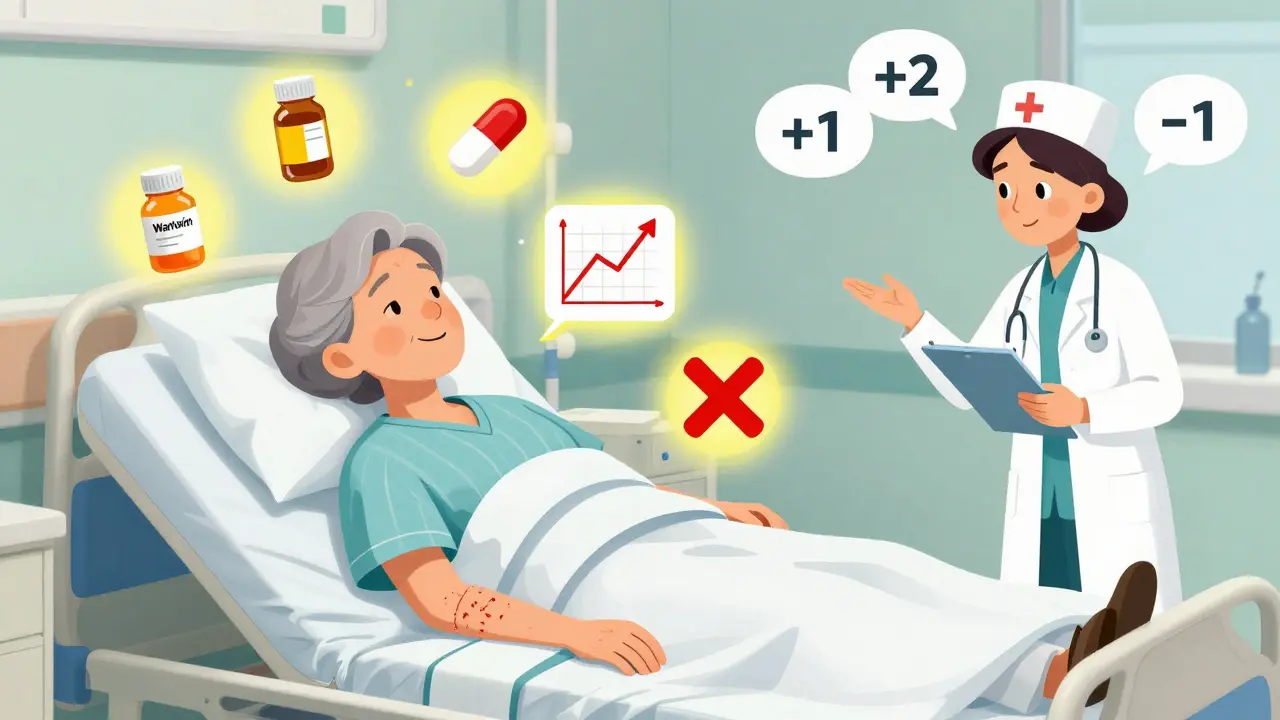
For example, a 72-year-old woman on warfarin develops bruising. Her INR is sky-high. She started a new antibiotic five days ago. The Naranjo Scale would give +2 for timing, +1 for improvement after stopping the antibiotic, +1 for known interaction between the antibiotic and warfarin, and -1 because the high INR itself explains the bruising. Total score: 3 - possible ADR. But if her INR was normal and she had no other risk factors, the score might jump to 7 - probable. The scale doesn’t tell you what to do. It tells you how sure you can be.
Why It’s Still Used Today
You’d think in 2026, with AI and electronic health records, a 40-year-old paper tool would be outdated. But it’s not. Why? Because it works. A 2022 study found that 78% of published ADR case reports used the Naranjo Scale - more than any other method. It’s cheap, easy, and doesn’t need fancy tech. Any nurse, pharmacist, or doctor can use it. In busy hospitals, where time is tight, it forces structure. Instead of saying, "I think this drug caused it," you say, "Here’s the evidence. Here’s the score."
It’s also built into reporting systems. In the U.S., when a pharmacy submits a serious adverse event to the FDA’s FAERS database, they’re expected to include a causality assessment - and the Naranjo Scale is the most common way to do it. Same in Europe. Even the WHO’s global drug safety program relies on it.
Where It Falls Short
But the Naranjo Scale isn’t perfect. One big problem? It’s made for one drug at a time. Most older patients take five, six, even ten medications. If someone gets dizziness after starting a new blood pressure pill, but they’re also on a diuretic, a statin, and an antidepressant - the scale can’t tell you which one did it. That’s why newer tools like the Liverpool Scale were created. They’re designed for polypharmacy.
Another issue: Question 6 asks if a placebo challenge was done. That means giving the patient a sugar pill to see if the reaction happens again. But in real life? That’s unethical. If a drug caused liver failure, you don’t give it back just to prove a point. Most clinicians just mark "don’t know" - which lowers the score and makes a definite reaction impossible to prove. Experts are now pushing to replace that question with something like, "Was there therapeutic drug monitoring data showing abnormal levels?"
And then there’s the question of modern drugs. The Naranjo Scale was built for aspirin, penicillin, and beta-blockers. It doesn’t handle immunotherapy or gene therapies well. Those drugs can cause reactions months after stopping - long after the scale’s "temporal relationship" window closes. A 2024 review in Nature Reviews Drug Discovery pointed out that the scale’s framework just doesn’t fit these new treatments.
Real-World Use: What Clinicians Say
On Reddit’s pharmacology forums, nurses and pharmacists share their experiences. One from Massachusetts General Hospital said, "We use it every day. It stops us from jumping to conclusions." Another from Johns Hopkins admitted, "We can’t rechallenge, so we’re stuck with ‘probable’ even when we’re 90% sure it’s the drug."
A 2023 study found that when hospitals switched from paper forms to a digital Naranjo calculator, assessment time dropped from 11 minutes to 4 minutes. Errors fell from 28% to 9%. That’s huge. Digital tools now auto-fill data from EHRs - like when a drug was started, when labs changed, or if the patient was discharged. That takes out the guesswork.
But even with tech help, training matters. A 2021 ASHP guideline says it takes 20-30 cases for someone to use the scale accurately. New grads often struggle with Question 5: "Are there other possible causes?" One pharmacist told me, "I thought a UTI explained the fever - my colleague thought it was the antibiotic. We scored it differently. We had to talk it out."
How to Learn It
You don’t need a PhD. Most hospitals train staff in a single 90-minute session. Free resources are available online. Fiveable, an educational platform, has 12 interactive case studies used by over 15,000 students. The Nebraska ASAP program offers a printable worksheet that’s been downloaded over 3,000 times. The International Society of Pharmacovigilance has a 27-page manual that walks you through every question with real examples.
Start with a simple case. Pick a patient who got a rash after a new antibiotic. Go through the 10 questions. Don’t skip the "don’t know" answers. Be honest. Then check your score. Compare it with a colleague. Talk about why you gave certain points. That’s how you learn.
What Comes Next?
The Naranjo Scale isn’t going away. But it’s changing. The International Council for Harmonisation (ICH) is drafting updates to make it fit modern ethics and drug types. AI tools are being tested - like the FDA’s Sentinel system - that use machine learning to predict ADR likelihood from millions of patient records. These might one day replace the scale in large databases.
But for now, in clinics, pharmacies, and hospitals, the Naranjo Scale is still the go-to. It’s not flashy. It doesn’t use AI. But it works. It turns hunches into evidence. It gives patients and regulators confidence that when a drug is pulled or a warning is added, it’s not based on opinion - it’s based on a clear, repeatable method. And in drug safety, that’s everything.
How accurate is the Naranjo Scale?
The Naranjo Scale has moderate reliability, with inter-rater agreement (kappa) between 0.4 and 0.6 in most studies. That means two clinicians using it on the same case will usually agree on whether it’s "probable" or "possible," but not always. Accuracy improves with training and experience. Digital tools reduce errors by 68%, mainly by preventing calculation mistakes and guiding users through ambiguous questions.
Can I use the Naranjo Scale for my patient at home?
Technically, yes - but it’s not meant for patients. The scale requires clinical knowledge to interpret answers, especially about alternative causes, drug interactions, and objective evidence. Patients don’t have access to lab results, medication histories, or drug mechanism data. It’s designed for healthcare professionals in hospitals, pharmacies, or regulatory agencies. If you suspect a reaction, talk to your doctor - don’t try to score it yourself.
Is the Naranjo Scale used for all types of drug reactions?
It’s used for most, but not all. It works best for reactions that appear quickly after taking a drug and resolve when it’s stopped - like rashes, nausea, or dizziness. It’s less reliable for delayed reactions (like liver damage from statins that shows up after months) or for immune-mediated reactions (like those from checkpoint inhibitors). For these, newer tools like ALDEN or the Liverpool Scale are preferred. The Naranjo Scale was designed for traditional small-molecule drugs, not biologics or gene therapies.
What’s the difference between the Naranjo Scale and WHO-UMC?
The Naranjo Scale uses a numerical score (0 to +13) to classify reactions as definite, probable, possible, or doubtful. The WHO-UMC system uses categories like "certain," "probable/likely," "possible," "unlikely," or "unassessable" - no numbers. Naranjo is more precise and reproducible, with better reliability between raters. WHO-UMC is simpler and faster, often used in spontaneous reporting systems where detailed data isn’t available. Naranjo is preferred in research and hospital settings; WHO-UMC is common in national pharmacovigilance centers.
Why is Question 6 about placebo challenges controversial?
Re-administering a drug that caused a serious reaction - even as a placebo - is considered unethical today. If a patient had kidney failure from a drug, giving it back, even in a sugar pill form, is dangerous and violates medical ethics. Most clinicians mark this question as "don’t know," which lowers the score and makes it harder to reach "definite." Experts agree this question needs to be replaced with safer alternatives, like checking drug levels or genetic markers, and ICH is already working on updates.



Nishant Garg
The Naranjo Scale is wild - it’s like a medical horoscope made by people who actually care about evidence. In India, we use it in rural clinics where even a basic EHR is a luxury. One nurse I know scores every rash like it’s a Sudoku puzzle - and somehow, it works. No fancy AI, no hospital IT department needed. Just a printed sheet, a pen, and someone willing to think before they blame the drug.
I’ve seen it save lives. A guy came in with fever and diarrhea after starting metronidazole. Everyone assumed it was gastroenteritis. But she ran the scale: +2 for timing, +1 for resolution after stopping, +2 for known interaction with his diabetes meds, -1 for possible food poisoning. Score: 4 - possible. They held off on antibiotics. Turned out it was a C. diff flare from the antibiotic. Naranjo caught it before the ER did.
It’s not perfect, but it’s honest. It forces you to admit when you don’t know. And in medicine, that’s half the battle.