
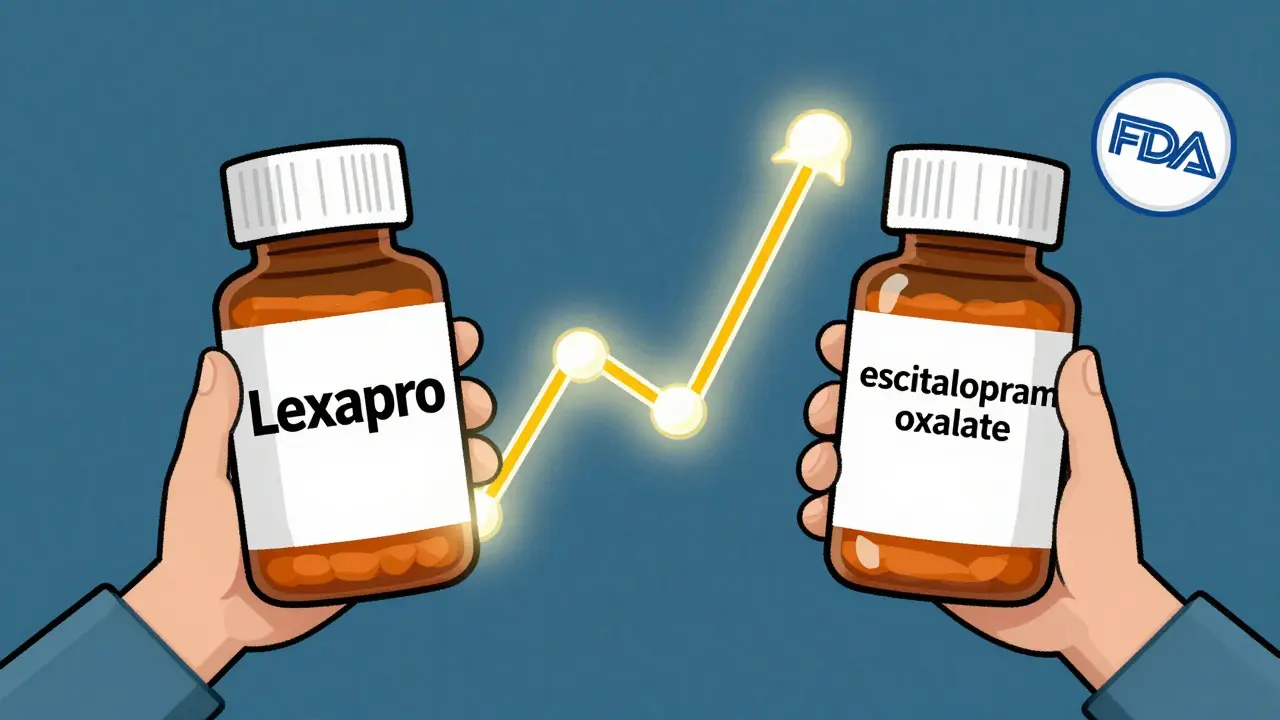
When you pick up a prescription, you might see two different names on the bottle: one that sounds familiar, like Lexapro, and another that looks like a chemical code, like escitalopram oxalate. You might wonder - is this generic version really the same? The answer lies in a term you’ve probably never heard but use every time you fill a prescription: bioequivalent.
What does "bioequivalent" actually mean?
Bioequivalent doesn’t mean two drugs look the same. It doesn’t even mean they’re made by the same company. It means that when you take them, your body absorbs them in nearly the same way. The active ingredient - the part that actually treats your condition - behaves the same in your bloodstream, no matter if it’s the brand name or the generic.The U.S. Food and Drug Administration (FDA) defines bioequivalence as "the absence of a significant difference in the rate and extent to which the active ingredient becomes available at the site of drug action." In plain terms: your body gets the same amount of medicine, at about the same speed, whether you take the brand or the generic.
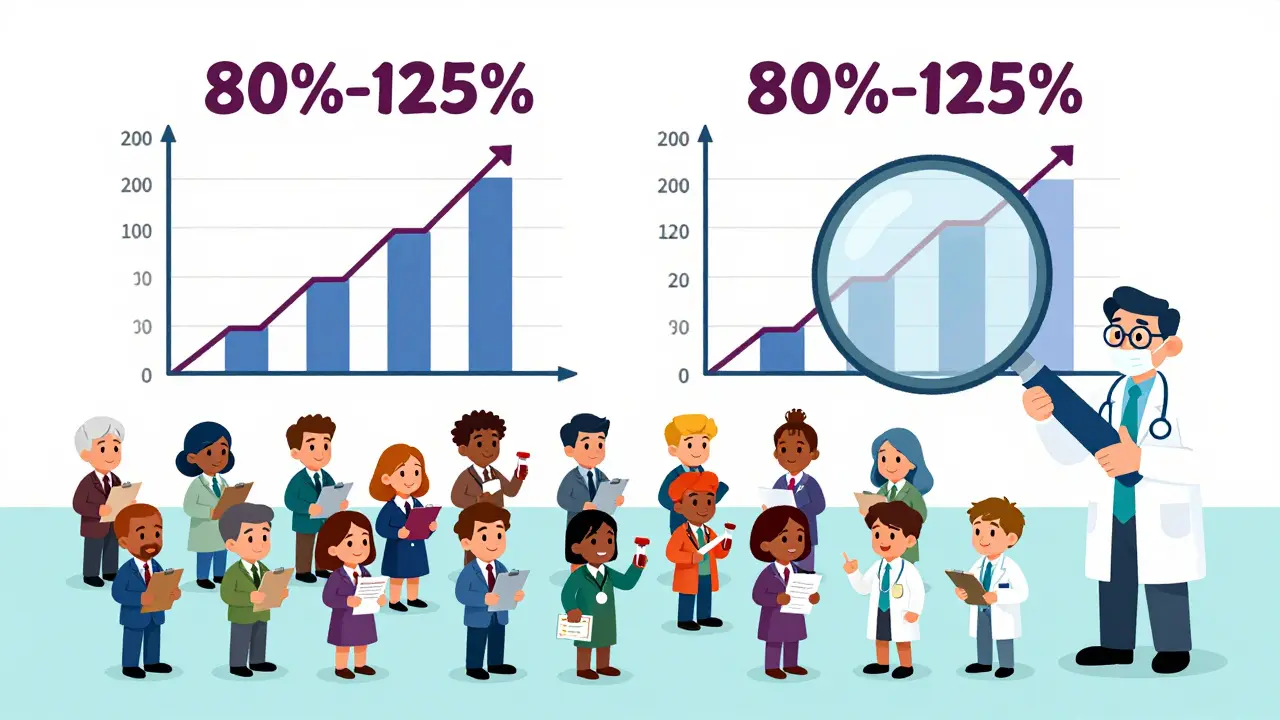
This isn’t just theory. It’s backed by real tests. Before a generic drug can be sold, the manufacturer must run studies on 24 to 36 healthy volunteers. They give half the group the brand-name drug, half the generic, then measure how much of the drug shows up in the blood over time. Two key numbers matter: Cmax (the highest concentration reached) and AUC (the total exposure over time). If the generic’s numbers fall within 80% to 125% of the brand’s, the FDA says it’s bioequivalent.
Why does the 80%-125% range matter?
You might think: "Why not 95%-105%? That seems safer." But here’s the thing - a 20% difference in drug levels is rarely meaningful. Think of it like driving. If you’re going 60 mph and someone else is going 50 or 70, you’re still going the same direction. The body can handle small variations without changing how the drug works.
This range isn’t random. It’s based on decades of data showing that differences under 20% don’t lead to noticeable changes in how well a drug works or how safe it is. For most medications - antibiotics, blood pressure pills, antidepressants - this works perfectly.
But there’s an exception: drugs with a narrow therapeutic index. These are medicines where the difference between a helpful dose and a dangerous one is tiny. Think levothyroxine (for thyroid), warfarin (a blood thinner), or some epilepsy drugs. For these, the FDA sometimes tightens the range to 90%-111%. That’s because even a 10% change could mean a seizure or a dangerous bleed.
Bioequivalent vs. Pharmaceutical Equivalent vs. Therapeutic Equivalent
These terms sound similar, but they’re not the same.
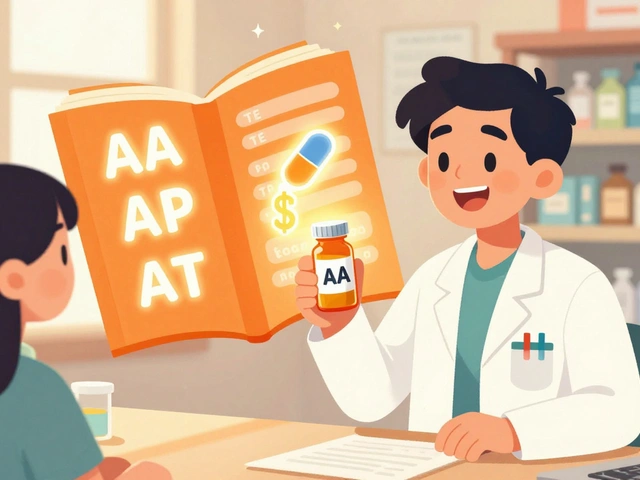
- Pharmaceutical equivalent means two drugs have the same active ingredient, dose, strength, and form (pill, injection, etc.). But they can have different fillers, colors, or coatings. That’s fine - those don’t affect how the drug works.
- Bioequivalent means those two pharmaceutical equivalents behave the same in your body. The numbers match.
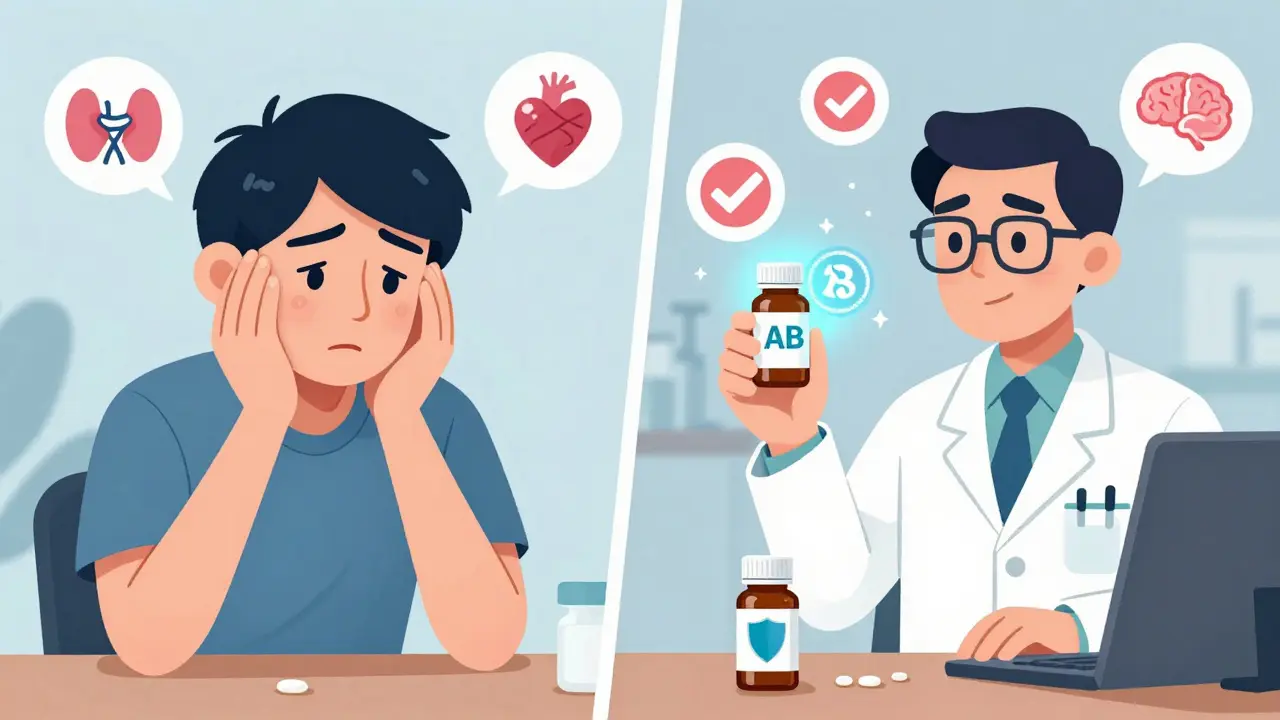
- Therapeutic equivalent is the gold standard. It means the drugs are both pharmaceutical and bioequivalent. The FDA gives these an "AB" rating in the Orange Book. If your prescription says "AB," you can swap it with confidence.
Not all generics get an "AB" rating. Some get "BX" - meaning there’s not enough data to prove they’re interchangeable. These are rare, but they exist. Always check the label or ask your pharmacist.
Do bioequivalent generics really work like brand names?
Yes - for most people, most of the time.
Here’s the data: In 2020, the FDA reviewed over 2,000 generic drug applications. Almost 99% had drug levels within 90%-110% of the brand. That’s tighter than the 80%-125% rule. It shows manufacturers are hitting the mark.
And the savings? Huge. Generic drugs save patients an average of $313 per prescription. Over the last decade, they’ve saved the U.S. healthcare system more than $2.2 trillion. That’s money back in people’s pockets.
But some patients report differences. On forums like Reddit, people talk about switching from brand to generic and feeling "off." For drugs like levothyroxine, that’s not uncommon. The thyroid is sensitive. Even a tiny shift in hormone levels can cause fatigue, weight changes, or mood swings. That’s why many doctors and pharmacists recommend sticking with the same generic manufacturer once you find one that works.
A 2022 survey of 1,245 independent pharmacists found 87% saw no meaningful difference between brand and generic drugs. Consumer Reports’ 2023 survey showed 78% of people were satisfied with generics - just 4% lower than brand-name users. The biggest gap? Antiepileptic drugs. That’s because seizures are all-or-nothing. A small drop in drug levels can trigger one.
And here’s something surprising: In 2022, only 0.3% of all adverse drug reports to the FDA were linked to generics. That’s proportional to their market share - they make up 90% of prescriptions, and they account for 0.3% of complaints. That’s not a red flag. That’s proof the system works.
What about other countries?
The U.S. uses 80%-125%. The European Medicines Agency (EMA) sometimes allows 75%-133% for drugs that vary a lot between people. That’s wider. But they also require testing under both fasting and fed conditions - meaning you have to take the drug with and without food. The FDA usually only tests one.
That’s why a generic made for the U.S. market might not be approved in Europe, and vice versa. It’s not about quality. It’s about rules. And those rules are based on science, not politics.
What about complex drugs - inhalers, creams, injections?
Not all drugs can be tested with blood samples. For inhalers, nasal sprays, or topical creams, the drug doesn’t enter the bloodstream the same way. So how do you prove they’re bioequivalent?
The FDA now uses alternative methods: comparing how the drug is released from the device, how it sticks to the skin, or even how it affects a patient’s symptoms in a clinical trial. In 2023 alone, the FDA released 27 new guidance documents for these complex products. The goal? Make sure even the trickiest generics work just as well.
What should you do?
- If you’re on a standard medication - blood pressure, cholesterol, acid reflux - generics are safe and effective. Stick with them.
- If you’re on a narrow therapeutic index drug - thyroid, seizure, blood thinner - talk to your doctor. If you switch generics and feel different, tell your pharmacist. They can help you stay on the same manufacturer.
- Don’t assume "generic" means "cheap and inferior." It means "tested and approved." The FDA doesn’t approve generics based on cost. They approve them based on science.
- Check the Orange Book (available online) if you want to know if your generic has an "AB" rating. Your pharmacist can help.
Bottom line: Bioequivalence isn’t a marketing term. It’s a scientific standard. And it’s why millions of people can afford their meds without sacrificing effectiveness.
Are generic drugs as strong as brand-name drugs?
Yes. Generic drugs contain the same active ingredient, in the same amount, as the brand-name version. The FDA requires them to be bioequivalent - meaning they deliver the same amount of medicine into your bloodstream at the same rate. The only differences are in inactive ingredients like fillers or dyes, which don’t affect how the drug works.
Can I switch between different generic versions of the same drug?
For most drugs, yes. But for medications with a narrow therapeutic index - like levothyroxine, warfarin, or certain seizure drugs - switching between generics from different manufacturers might cause small changes in how your body responds. If you notice symptoms changing after a switch, talk to your pharmacist. They can help you stay on the same brand of generic.
Why do some generics cost so much less than brand-name drugs?
Brand-name drugs go through expensive clinical trials to prove they’re safe and effective. Generic manufacturers don’t repeat those trials. Instead, they prove bioequivalence through smaller, cheaper studies. They also don’t spend millions on advertising. That’s why generics cost 80%-85% less on average.
Do all generic drugs have an "AB" rating?
No. The FDA assigns "AB" only to generics that have been proven bioequivalent through pharmacokinetic studies. Some drugs - especially complex ones like inhalers or topical creams - may get an "BX" rating, meaning there isn’t enough data yet to confirm interchangeability. Always ask your pharmacist if your generic has an "AB" rating.
Is it true that some people have bad reactions to generic drugs?
Rarely. Most reported issues are not due to the drug being ineffective, but because of individual sensitivity - especially with thyroid or seizure medications. The FDA’s adverse event database shows only 0.3% of all reports involve generics, which matches their market share. If you feel different after switching, it’s worth reporting to your doctor and pharmacist. It’s not common, but it happens.




Darren Torpey
Yo, this post is a total game-changer. I used to think generics were just cheap knockoffs, but now I get it - it’s not about the label, it’s about what’s happening in your bloodstream. That 80%-125% range? Genius. It’s like saying two cars can both get you from LA to Vegas even if one has leather seats and the other has cloth. Both get you there, just with different vibes.
And honestly? I switched my antidepressant to generic last year and didn’t even notice. My wallet cried tears of joy. The FDA ain’t playing. They’re scientists, not salespeople.