

Imagine a drug that combines two active ingredients in one pill. Sounds simple, right? But getting generic versions of these combination products approved is anything but easy. In fact, nearly 73% of new drugs approved between 2010-2019 were complex combination products, yet their generic versions take twice as long to reach market compared to single-drug generics. This isn’t just a technical issue-it affects how quickly affordable treatments reach patients worldwide.
The concept of bioequivalence of combination products is critical for ensuring generic versions work as well as brand-name drugs. Combination Products are pharmaceutical products that combine two or more active ingredients or a drug with a device, designed to deliver multiple therapeutic effects in a single administration. For these products, bioequivalence means proving the generic version delivers the same active substances at the same rate and extent as the brand-name product. This avoids the need for costly clinical trials, saving healthcare systems billions. Generic drugs saved the U.S. healthcare system $373 billion in 2020 alone, but combination products make this process far harder.
Why Combination Products Pose Unique Testing Challenges
Single-drug bioequivalence testing typically involves 24-36 healthy volunteers in a two-way crossover study. For combination products, this gets messy fast. Fixed-Dose Combinations (FDCs) are products combining two or more active pharmaceutical ingredients (APIs) in a single dosage form. When APIs interact-like one making the other less absorbable-their combined effect can’t be predicted from individual tests. The U.S. Food and Drug Administration (FDA) the primary regulatory agency for drug approval in the United States requires testing against both individual components and the combined reference product. This means three-way crossover studies with 40-60 subjects, increasing costs and complexity.
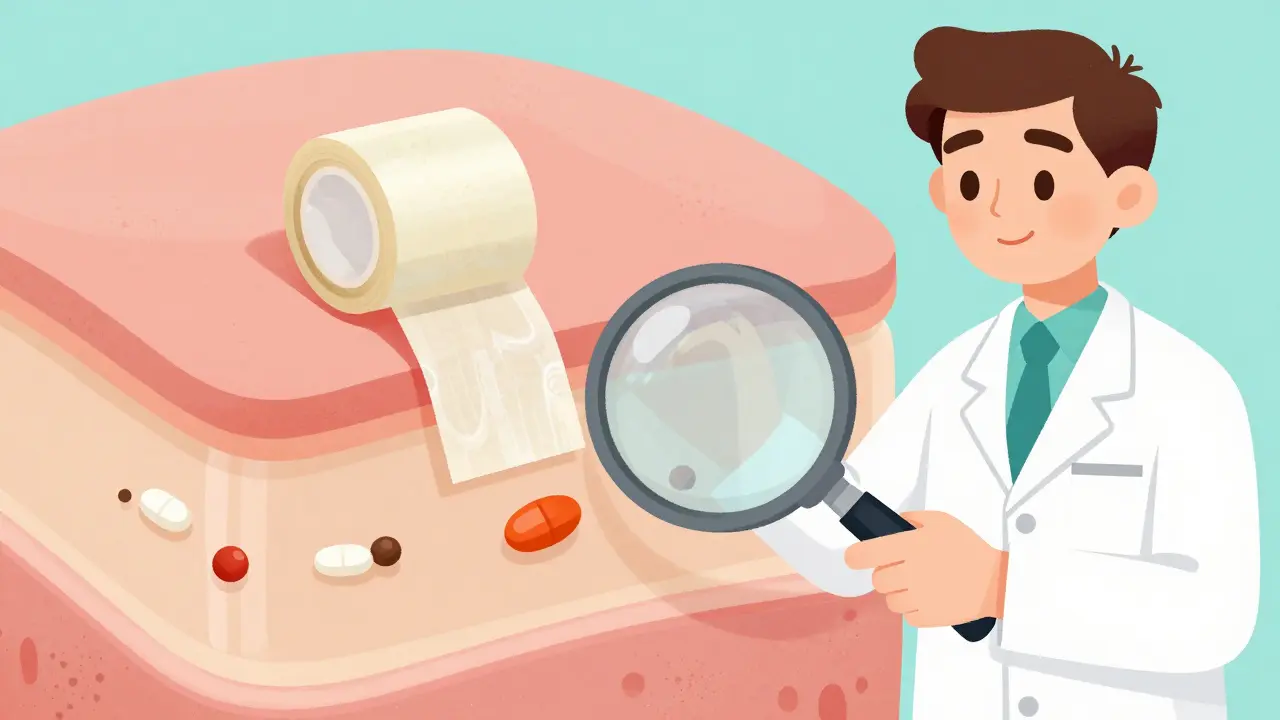
Take topical products like creams or ointments. Topical Dermatological Products are drug formulations applied to the skin, requiring precise delivery to the stratum corneum layer. Measuring how much drug actually penetrates the skin is tricky. Current FDA guidance uses tape-stripping to collect skin layers, but there’s no standard on how many layers or how much to analyze. In one case, a generic version of calcipotriene/betamethasone dipropionate foam failed three consecutive bioequivalence studies because of inconsistent drug penetration measurements. Clinical endpoint studies for these products require 200-300 patients per arm and cost $5-10 million-far more than the $1-2 million for standard studies.
Drug-Device Combination Products (DDCPs) are products combining a drug with a delivery device, such as inhalers or injectors, add another layer of complexity. A slight design change in an inhaler can alter how much drug reaches the lungs. The European Medicines Agency (EMA) the regulatory agency for medicines in the European Union and FDA both require testing aerosol particle size distribution. For metered dose inhalers, particle size must stay within 80-120% of the reference product. Dr. William Doub of the FDA’s Division of Complex Drug Products noted that 65% of complete response letters for DDCPs cite user interface issues as the main reason for rejection. This means even if the drug works, a poorly designed device can block approval.
| Product Type | Key Challenges | Regulatory Requirements | Failure Rate |
|---|---|---|---|
| Fixed-Dose Combinations (FDCs) | Interactions between APIs altering drug behavior | Three-way crossover studies, testing both components | 25-30% higher failure than single-entity drugs |
| Topical Dermatological Products | Measuring drug delivery to skin layers | Tape-stripping procedures, clinical endpoint studies | Up to 40% initial study failures |
| Drug-Device Combination Products (DDCPs) | User interface differences affecting delivery | Aerosol particle size, inhaler design testing | 65% of complete response letters cite UI issues |
Regulatory Hurdles and Global Differences
Regulatory agencies like the World Health Organization (WHO) the international body setting global health standards, FDA, and EMA have different rules for combination products. The FDA’s 2023 guidance requires FDC developers to prove bioequivalence to both individual components and the combined product. Meanwhile, the EMA often demands additional clinical data for 23% of complex product submissions compared to the FDA. This duplication of efforts increases development costs by 15-20% for global approvals.
Generic drug manufacturers face inconsistent feedback from regulators. Between 2021-2023, 78 industry submissions to the FDA’s GDUFA public docket cited "lack of clear bioequivalence pathways" as the top barrier. Teva Pharmaceuticals reported 42% of their complex product development failures were due to bioequivalence study issues, especially with modified-release FDCs. Mylan (now Viatris) documented that topical product development timelines increased by 18-24 months due to testing complexities. Small companies are hit hardest-they lack resources to navigate these hurdles, with 89% of generic companies calling current requirements "unreasonably challenging" for complex products.
Solutions and Innovations
Despite the challenges, new approaches are emerging. Physiologically-Based Pharmacokinetic (PBPK) Modeling a computational method simulating drug behavior in the body has been accepted in 17 approved ANDAs (Abbreviated New Drug Applications) as of Q2 2024. This reduces required clinical studies by 30-50%, saving millions. For example, a PBPK model for a topical FDC cut development time by 10 months compared to traditional methods.
The FDA’s Complex Product Consortium a collaborative initiative to standardize testing for complex products, launched in 2021, has developed 12 product-specific bioequivalence recommendations. Participating companies saw development timelines drop by 8-12 months. Early engagement through Type II meetings has increased by 220% since 2020, helping companies avoid dead ends.
For topical products, in vitro-in vivo correlation (IVIVC) modeling shows promise. Pilot studies demonstrated 85% predictability of in vivo performance from in vitro tape-stripping data. The FDA’s collaboration with NIST to develop reference standards for complex products aims to address analytical variability. Initial standards for inhalation products are expected in late 2024.

Future Outlook
The global complex generic market hit $112.7 billion in 2023, but regulatory hurdles remain. FDA data shows complex product ANDAs take 38.2 months for first-cycle approval versus 14.5 months for standard generics. Patent thickets have delayed generic entry by 2.3 years on average. However, the FDA’s 2024 draft guidance includes 15 new complex product recommendations, and the "Bioequivalence Modernization Initiative" targets 50 new product-specific guidances by 2027. Resolving these challenges could accelerate generic entry for $78 billion in complex product sales by 2028. Without action, 45% of complex brand products may lack generic competition through 2030.
What is bioequivalence for combination products?
Bioequivalence for combination products means proving a generic version delivers the same active ingredients at the same rate and extent as the brand product. This avoids full clinical trials, ensuring therapeutic equivalence. For combination products, this is harder than single-drug products because multiple components can interact, affecting absorption and effectiveness.
Why is testing combination products harder than single-drug products?
Single-drug tests usually involve 24-36 volunteers in a two-way crossover study. Combination products often require larger sample sizes (40-60 subjects), more complex study designs (like three-way crossovers), and sometimes clinical endpoint trials with hundreds of patients. For example, topical products need $5-10 million studies to measure skin penetration, while standard bioequivalence studies cost $1-2 million.
How do regulatory agencies handle bioequivalence for complex products?
Regulatory agencies like the FDA and EMA have specific guidelines for different combination product types. The FDA requires FDCs to be tested against both individual components and the combined product. For topical products, they use tape-stripping procedures to measure skin delivery. Drug-device combinations require testing device performance alongside drug delivery. However, inconsistencies between agencies create duplication of efforts, increasing costs by 15-20% for global approvals.
What are the biggest challenges for generic manufacturers?
Generic manufacturers face high failure rates: 25-30% higher for FDCs than single-drug products, and up to 40% for topical products. Development timelines increase by 18-24 months for topical products. Drug-device combinations often fail due to user interface issues, with 65% of complete response letters citing this. Small companies struggle most, lacking resources to navigate inconsistent regulatory feedback and costly testing requirements.
Are there solutions to speed up testing?
Yes. Physiologically-Based Pharmacokinetic (PBPK) modeling has been accepted in 17 approved ANDAs and reduces clinical studies by 30-50%. The FDA’s Complex Product Consortium has cut development timelines by 8-12 months for participating companies. In vitro-in vivo correlation (IVIVC) modeling for topical products shows 85% predictability of in vivo performance. New reference standards from NIST will address analytical variability for inhalation products by late 2024.



jan civil
Combination products' bioequivalence challenges are a major barrier to affordable generics.