
LDL Reduction Estimator for Alternate-Day Statin Dosing
This tool estimates the LDL reduction you might experience when switching from daily to alternate-day dosing of atorvastatin or rosuvastatin. Remember: this approach only works for certain statins and patients. Your doctor should always approve any change to your medication regimen.
Results
Cost Savings
--
Your Recommendation
--
What if you could cut your statin dose in half - and still keep your LDL cholesterol under control - while finally feeling like yourself again? For millions of people who can’t tolerate daily statins, this isn’t science fiction. It’s a real, evidence-backed option: alternate-day statin dosing.
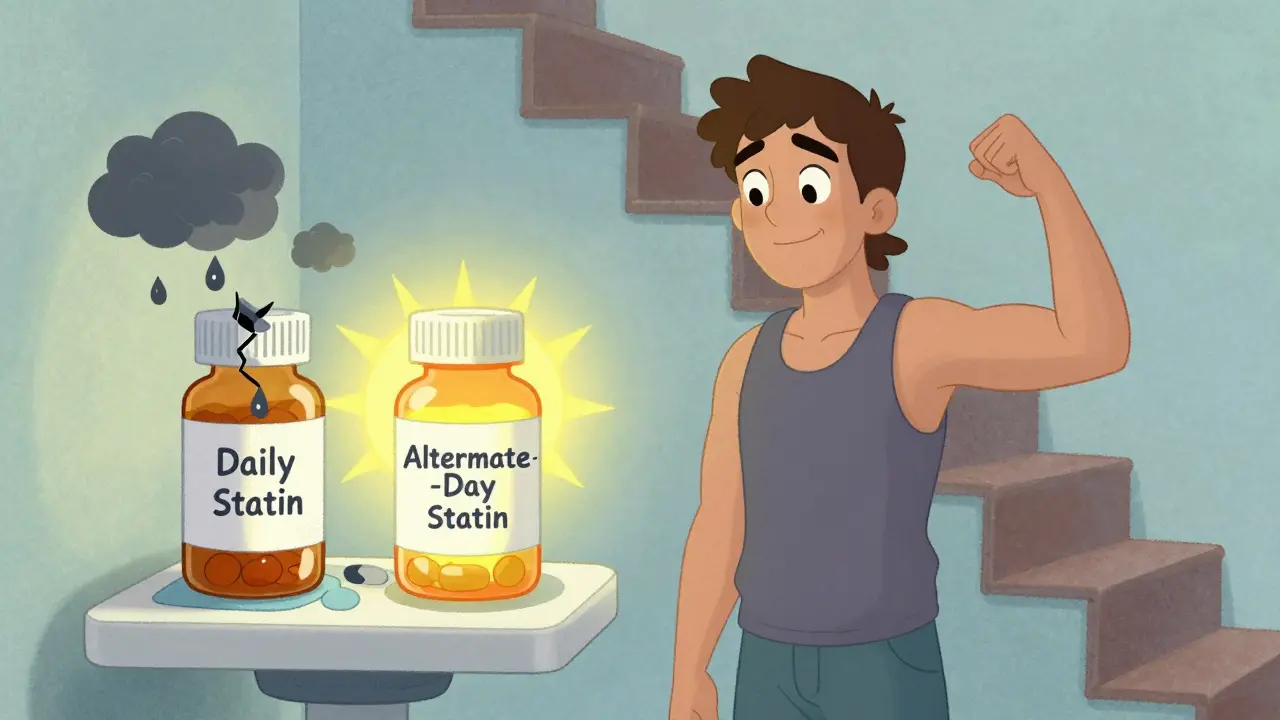
Statin intolerance isn’t rare. About 1 in 7 people who take statins report muscle pain, weakness, or fatigue so bad they stop taking them. For many, it’s not just discomfort - it’s losing the ability to walk, climb stairs, or even play with their kids. Daily statins work great for lowering LDL, but if your body won’t tolerate them, what’s left?
Turns out, skipping a day might be the answer.
Why Alternate-Day Dosing Works
Not all statins are the same. Some, like atorvastatin and rosuvastatin, stick around in your body for a long time - up to 30 hours. That means even if you take them every other day, there’s still enough drug in your system to block cholesterol production. Daily dosing isn’t always necessary.
A 2012 study of 38 people with high cholesterol compared daily 20 mg atorvastatin to every-other-day 20 mg. After 12 weeks, LDL dropped by 44.1% on the daily dose and 42.3% on the alternate-day schedule. The difference? Statistically meaningless. Total cholesterol dropped almost identically too. This wasn’t a fluke. Multiple studies since then have shown the same pattern: you lose almost nothing in LDL reduction by switching to every other day.
The real win? Side effects. In one study, 23 patients who couldn’t handle daily atorvastatin or rosuvastatin - full muscle pain, stopped working out, felt tired all the time - switched to the same drug every other day. Nearly 9 out of 10 tolerated it. Zero tolerated the daily version. That’s not a small improvement. That’s life-changing.
Who Should Consider This?
This isn’t for everyone. Alternate-day dosing works best if you meet a few key criteria:
- You’ve tried at least two different daily statins and had muscle symptoms (myalgia) that forced you to stop.
- Your creatine kinase (CK) levels aren’t sky-high - under 10 times the normal limit. High CK means real muscle damage, not just soreness.
- You have high cardiovascular risk - already had a heart attack, stroke, diabetes, or very high LDL.
- You’re taking atorvastatin or rosuvastatin. Other statins like simvastatin or pravastatin don’t last long enough in your body to make this work.
If you’re on a low-dose statin and your LDL is barely budging, alternate-day dosing probably won’t help. You need enough starting dose to make the every-other-day version effective. Most studies use 10-20 mg of atorvastatin or 5-10 mg of rosuvastatin.
How Much LDL Do You Really Lose?
Let’s be clear: alternate-day dosing doesn’t match daily dosing 100%. But it doesn’t need to.
A 2017 meta-analysis of 12 studies found that alternate-day statin regimens achieved 92-95% of the LDL-lowering power of daily dosing. On average, LDL dropped just 3.2 mg/dL less than with daily pills. For someone with an LDL of 160, that’s still a drop to around 110 - far below the 130 threshold most doctors want to see.
But here’s the catch: if your goal is an LDL under 70 (like after a heart attack), alternate-day dosing might not get you there alone. That’s where combination therapy comes in.
Some patients add ezetimibe (Zetia) - a non-statin pill that blocks cholesterol absorption in the gut. One study gave patients rosuvastatin every other day plus ezetimibe daily. Their LDL dropped 41%. Muscle side effects? Only 14%. That’s better than most daily statins.
Another option? Colesevelam, a bile acid binder. One group of patients took rosuvastatin twice a week, ezetimibe twice a week, and six pills of colesevelam daily. Their LDL stayed as low as it did on daily statins. But six pills a day? That’s a lot. Some people can’t swallow that many pills - and that’s a real barrier.
Side Effects: The Real Advantage
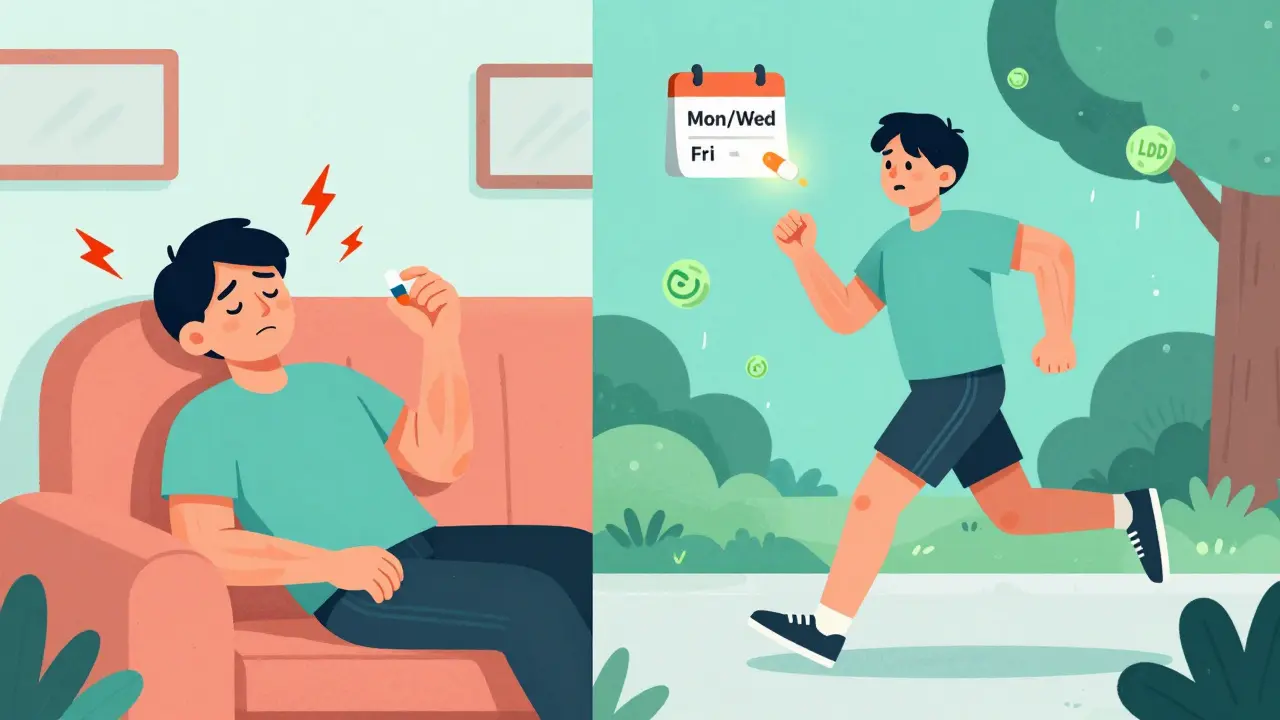
The biggest reason people switch to alternate-day dosing? Muscle pain vanishes.
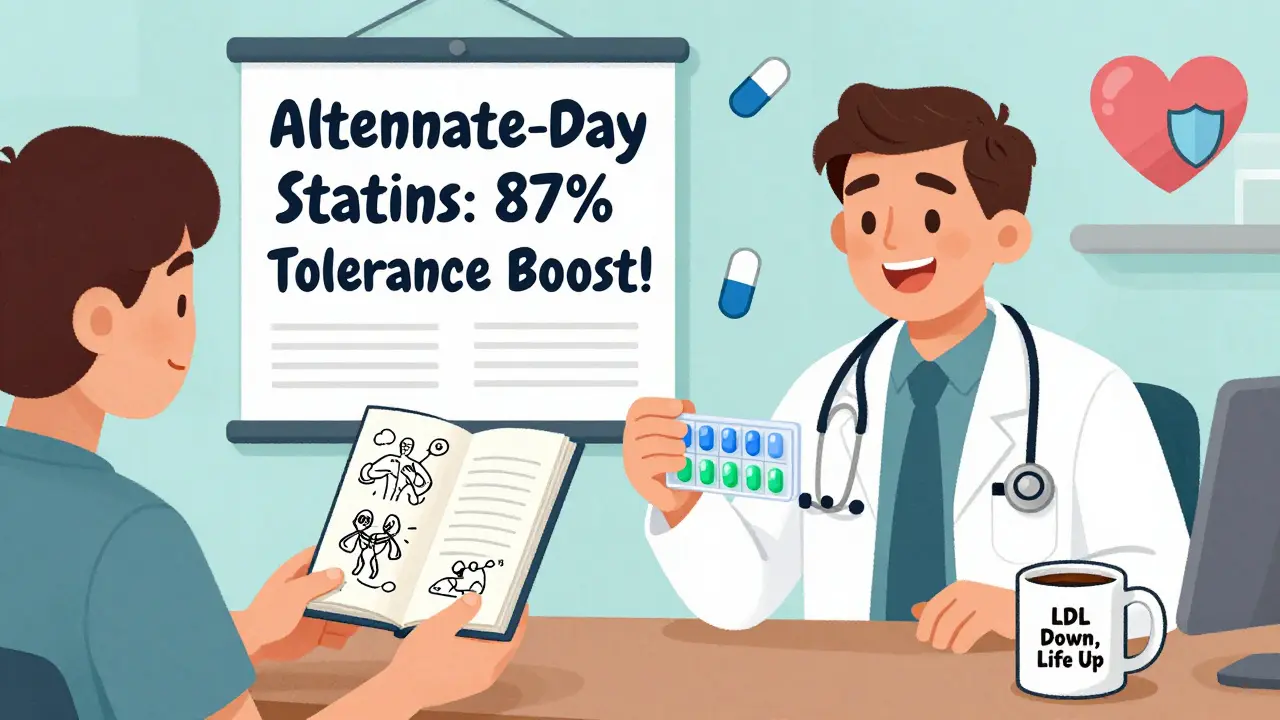
Statin-associated muscle symptoms (SAMS) affect 10-15% of users. For some, it’s mild soreness. For others, it’s crippling. Studies show alternate-day dosing cuts muscle side effects by 30-50%. In one trial, 87% of patients who couldn’t tolerate daily statins had no muscle pain on every-other-day dosing.
It’s not just about pain. People report improved energy, better sleep, and the ability to move again. One patient told his doctor, “I can finally walk up the stairs without stopping.” Another said, “I’m back at the gym - and I haven’t felt this good in years.”
There’s no evidence this approach increases liver damage, diabetes risk, or cognitive issues - the other common statin worries. The same safety profile holds up.
Cost and Convenience
Let’s talk money. A 30-day supply of generic atorvastatin 20 mg costs about $5. If you take it every other day, you’re using half the pills - so half the cost. That’s $30 a year instead of $60. For rosuvastatin, it’s $60 a year instead of $120.
Compare that to the alternatives:
- Ezetimibe (Zetia): $300/month
- Bempedoic acid (Nexletol): $480/month
- PCSK9 inhibitors (Repatha, Praluent): $5,000-$14,000/year
Alternate-day statin dosing isn’t just effective - it’s the cheapest option that still delivers real LDL reduction. And it keeps you on a statin, which means you’re still getting the anti-inflammatory and plaque-stabilizing benefits (the “pleiotropic effects”) that newer drugs don’t fully replicate.
What Doesn’t Work
Not every statin can do this. Simvastatin, lovastatin, pravastatin, and fluvastatin have short half-lives - they’re out of your system in 1-4 hours. Skipping a day means your LDL rises back up before the next dose. These won’t work for alternate-day dosing.
Also, don’t try this without medical supervision. You can’t just start skipping pills on your own. Your doctor needs to confirm your statin intolerance is real, not just “I didn’t like the side effects.” They’ll check your CK levels, review your heart risk, and pick the right dose.
And no - once-weekly dosing isn’t reliable. One study gave rosuvastatin once a week. Only 27% of patients hit their LDL goal. Twice-weekly (every other day) works much better.
How to Get Started
If you’re considering this, here’s how to approach it:
- Confirm you have true statin intolerance - not just mild discomfort. Keep a symptom journal.
- Ask your doctor to test your CK levels. If they’re normal or only slightly elevated, you’re a good candidate.
- Switch to atorvastatin or rosuvastatin if you’re not already on them.
- Start with the same daily dose you were on, but take it every other day. Example: 20 mg on Monday, skip Tuesday, 20 mg Wednesday, skip Thursday, etc.
- Get your LDL checked after 4-6 weeks. If it’s not down enough, your doctor might add ezetimibe.
- Use a pill organizer or phone reminder. Skipping doses can be confusing - especially if you’re used to daily routines.
Many doctors don’t bring this up. But if you’ve struggled with statin side effects, it’s worth asking. A 2020 survey found 68% of lipid specialists use this strategy regularly - but only 59% of general practitioners do. You might need to educate your doctor.
What’s Missing?
There’s one big hole in the evidence: long-term heart outcomes. We know alternate-day dosing lowers LDL and reduces side effects. But we don’t have large, long-term studies showing it prevents heart attacks or strokes like daily statins do.
That’s why the American College of Cardiology says this should only be used after you’ve failed daily statins. They’re not against it - they just want to be sure you’re not giving up on proven therapy too soon.
But here’s the reality: millions of people have already stopped statins because of side effects. And without statins, their heart risk stays high. Alternate-day dosing is the best bridge we have between doing nothing and taking a daily pill that makes you feel worse.
Final Thoughts
Alternate-day statin dosing isn’t a miracle. But for people who can’t tolerate daily pills, it’s the most practical, affordable, and effective option we have right now. It doesn’t cure statin intolerance - but it lets you live with it.
If you’ve been told you need a statin but can’t take one, don’t give up. Ask about atorvastatin or rosuvastatin every other day. Bring the studies. Bring your symptoms. Bring your frustration. This isn’t experimental - it’s evidence-based. And it’s helping real people get their lives back.



Bobbi-Marie Nova
So let me get this straight - you’re telling me I can take my statin every other day, save half the cash, and actually sleep through the night again? And this isn’t some shady internet hack? I’m sold. My legs haven’t stopped aching since 2021. Time to talk to my doc.