
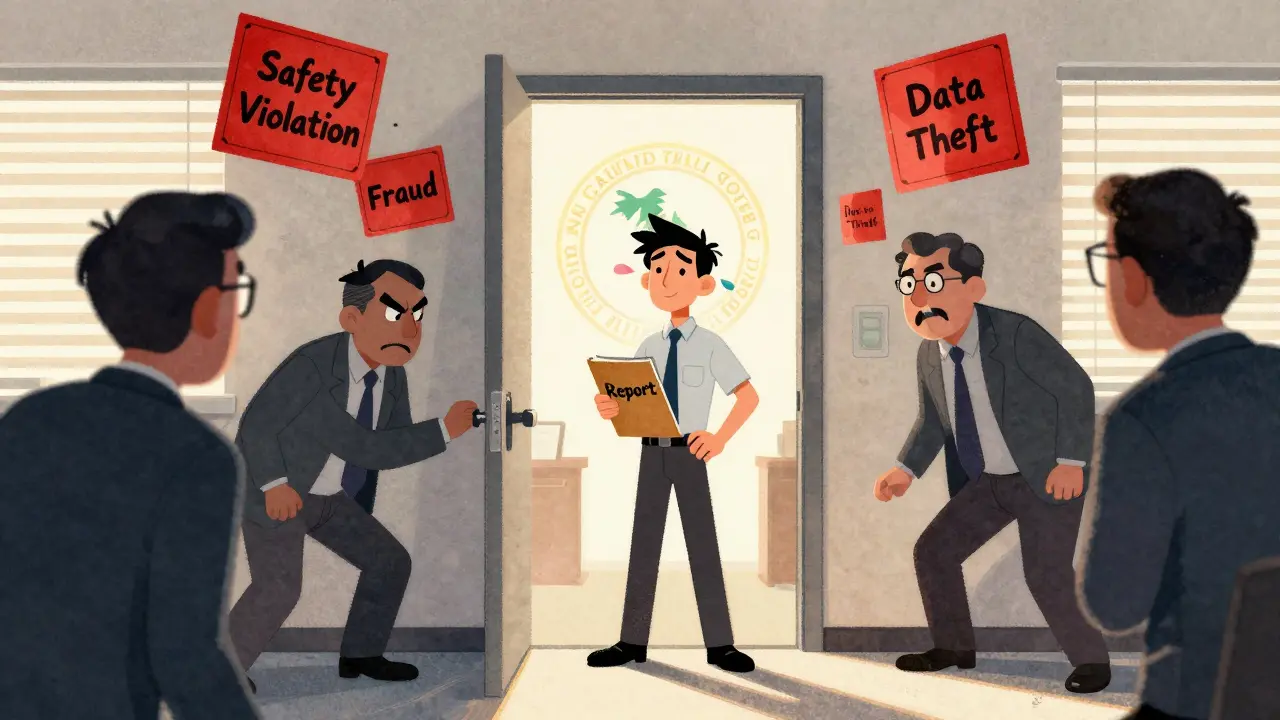
When you see something wrong at work-safety hazards, financial fraud, environmental damage, or unethical practices-what do you do? Reporting it might feel risky. You might fear losing your job, getting pushed to the margins, or being labeled a troublemaker. But whistleblower laws exist to protect you when you speak up. They’re not just legal technicalities; they’re lifelines for people who refuse to stay silent.
What Counts as Protected Reporting?
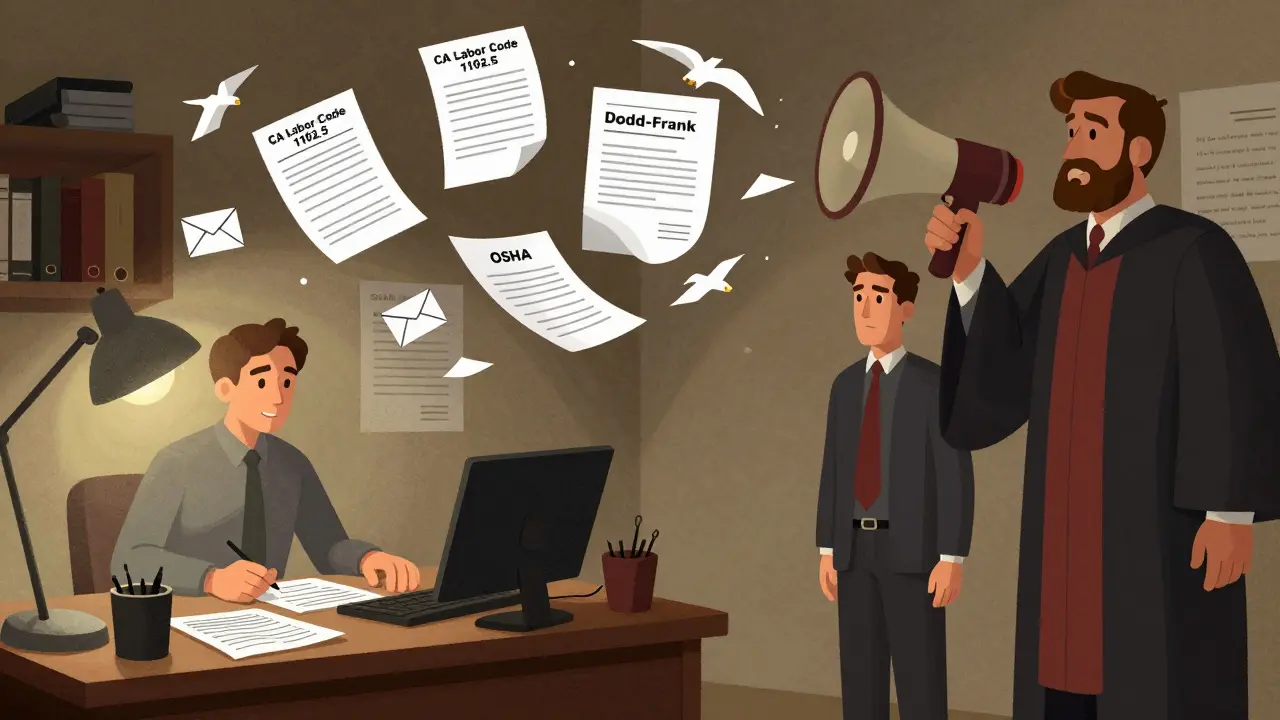
Whistleblower protections don’t just cover grand, dramatic exposures. They protect everyday workers who report violations they reasonably believe are happening. Under California’s Labor Code Section 1102.5, which applies to nearly all workers in the state, protected activity includes telling your manager, HR, or a government agency about suspected violations of state or federal laws. It doesn’t matter if you’re 100% sure-only that you have a good-faith belief. That means reporting a coworker cutting corners on safety checks, a supervisor hiding financial records, or a company dumping toxic waste could all qualify.These protections extend beyond current employees. Job applicants who report violations during the hiring process are covered. Even people who are just thought to be whistleblowers-like someone who asked a question about compliance-can’t be punished just because their boss suspects they might report something. The law is designed to chill retaliation before it starts.
What Counts as Retaliation?
Retaliation isn’t always firing someone. It’s often quieter, sneakier, and harder to prove. The law lists several prohibited actions:- Termination or forced resignation
- Demotion or removal of responsibilities
- Reduction in pay or hours
- Denial of promotions or raises
- Unfair performance reviews
- Being assigned undesirable shifts or locations
- Creating a hostile work environment-constant monitoring, public shaming, or exclusion
One worker on Reddit described how, after reporting OSHA violations, they were suddenly switched to overnight shifts with no notice. They couldn’t afford childcare and had to quit. That’s retaliation. Another employee said their manager started documenting every minor mistake after they filed an internal complaint-only to use those notes as "evidence" for termination. That’s also retaliation.
These aren’t isolated stories. A 2024 survey by the National Whistleblower Center found that 68% of whistleblowers still faced some form of retaliation, even with laws in place. The most common tactic? Making the workplace unbearable until the person leaves on their own.
Federal vs. State Protections: What’s the Difference?
The U.S. doesn’t have one unified whistleblower law. Instead, it’s a patchwork. Federal laws protect people in specific industries or for specific violations. For example:- The Sarbanes-Oxley Act protects employees of public companies who report financial fraud.
- The False Claims Act covers those reporting fraud against government programs like Medicare or defense contracts.
- The Dodd-Frank Act goes further-it offers financial rewards. If your information leads to a fine over $1 million, you could get 10% to 30% of that amount.
- The AIR21 Act protects airline workers who report safety issues.
But California’s law is broader. Section 1102.5 doesn’t limit you to fraud or safety. It covers any violation of state or federal law-whether it’s wage theft, discrimination, environmental violations, or even illegal data collection. And starting January 1, 2025, every employer in California must visibly post the state’s whistleblower rights notice in a place all employees can see. The notice must be in at least 14-point font and include the Attorney General’s hotline: 1-800-952-5225. Failure to post it can cost a business up to $10,000 per violation.
That’s a big deal. Federal law doesn’t require employers to post anything. California is forcing transparency.
Deadlines Matter-And They’re Tight
Protecting your rights isn’t just about knowing the law. It’s about acting fast. Each federal law has its own deadline for filing a complaint with OSHA. Miss it, and you lose your case.- 30 days: Clean Air Act, CERCLA (Superfund)
- 90 days: Anti-Money Laundering Act, Asbestos Hazard Emergency Response Act
- 180 days: Consumer Financial Protection Act, Consumer Product Safety Improvement Act
California’s law doesn’t have a strict deadline, but delays hurt your case. The Division of Labor Standards Enforcement (DLSE) says evidence fades quickly. If you wait six months to report retaliation, witnesses move on, emails get deleted, and your claim becomes harder to prove.
And here’s a harsh truth: OSHA misses its own deadlines. A 2024 Department of Labor report found that 63% of federal whistleblower complaints weren’t investigated within the required 90 days. That means you might wait over a year just to get an initial response.
What You Need to Do-Step by Step
If you’re considering reporting a violation, here’s what actually works:- Document everything. Save emails, texts, performance reviews, shift schedules, and witness names. Write down dates, times, and what was said. Retaliation often comes disguised as "normal" management-so paper trails are your shield.
- Know your rights. Check California’s Labor Commissioner website for the official whistleblower notice. If you’re in another state, search for your state’s labor department site. Federal protections vary by industry-know which one applies to you.
- Report internally first (if safe). Many companies have compliance hotlines or ethics officers. But don’t assume HR has your back. They work for the company. If you suspect they’ll side with management, go straight to a government agency.
- Call a lawyer. The National Whistleblower Center says 78% of successful cases had legal representation. You don’t need a fancy law firm. Look for nonprofits or legal aid groups that specialize in employment law. Many offer free consultations.
- File on time. If you’re using a federal law, file with OSHA before the deadline. For California, file with the DLSE as soon as retaliation happens. Don’t wait for "the right moment." The moment is now.
Real Cases, Real Outcomes
A nurse in Los Angeles reported unsafe patient ratios. She was fired two weeks later. With help from a whistleblower attorney, she filed a claim under California Labor Code 1102.5. After 14 months, she won $287,000 in back pay and reinstatement. That’s one case. Another worker at a tech startup in San Francisco reported that his company was illegally collecting user data. He was quietly demoted, then laid off. He didn’t have a lawyer. His case was dismissed because he couldn’t prove the company knew he was going to report it. He lost everything.The difference? Preparation.
What’s Changing in 2025?
California’s 2025 posting requirement is just the start. The National Whistleblower Center has seven major campaigns for this year. One is pushing for the AI Whistleblower Protection Act, introduced by Senator Grassley in May 2025. It would protect engineers and developers who report unethical AI practices-like biased algorithms, data manipulation, or hidden surveillance tools. Right now, those workers have no federal protection.Another campaign wants to let federal whistleblowers sue in federal court. Right now, most can only go through OSHA’s slow administrative process. That means delays, inconsistent rulings, and no jury. The proposed Congressional Whistleblower Protection Act would change that.
And enforcement is tightening. The Department of Labor is working on new rules to cut investigation times from 90 days to 60. If passed, it’ll be the biggest overhaul in decades.
Where to Get Help
You’re not alone. Resources exist:- California Attorney General’s Whistleblower Hotline: 1-800-952-5225 (free advice, multilingual)
- OSHA Whistleblower Protection Program: 1-800-321-6742
- National Whistleblower Center: Offers free legal support, training, and advocacy. They helped 1,247 people in 2024.
- Local legal aid clinics: Many cities have nonprofits that handle employment law for low-income workers.
And if you’re in a small business? You’re required to post the notice too. The California Chamber of Commerce estimates 65% of small employers didn’t know about the 2025 rule as of late 2024. Ignorance isn’t a defense. If you’re an employer, this isn’t about compliance-it’s about culture. Protecting people who speak up makes your company stronger.
Why This Matters
Whistleblower laws aren’t about turning people into snitches. They’re about keeping systems honest. Fraud, safety violations, and corruption cost billions every year. The Congressional Budget Office estimated that better whistleblower protections could save taxpayers $12.7 billion annually. That’s not abstract. It’s money that could go to hospitals, schools, or clean energy.And it’s not just about money. It’s about trust. When workers know they can speak up without fear, companies become safer, fairer, and more accountable. The best companies don’t fear whistleblowers-they welcome them.
Can I be fired for reporting a violation if I’m an at-will employee?
Yes, you can be fired-but not because you reported a violation. At-will employment means your employer can fire you for almost any reason, except illegal ones. Whistleblower laws make retaliation illegal, even in at-will states. If you’re fired after reporting, you can sue for wrongful termination based on whistleblower protections. The burden is on your employer to prove the firing was for a legal reason.
What if I report anonymously?
You can report anonymously through many government hotlines or company compliance systems. But anonymity makes it harder to prove retaliation later. If you’re fired and can’t prove you were the one who reported, your case may be dismissed. If possible, use your name but document everything. You can still request confidentiality from the agency you report to.
Do whistleblower laws protect contractors and gig workers?
Most state laws, including California’s, only protect employees. Independent contractors and gig workers are generally not covered. However, some federal laws like the False Claims Act and Dodd-Frank Act do cover contractors who report fraud against the government. Always check the specific law that applies to your situation.
Can I be sued for reporting something that turns out to be wrong?
Not if you acted in good faith. Whistleblower laws protect you even if your report turns out to be inaccurate, as long as you had a reasonable belief that a violation occurred. Malicious or false reports with intent to harm can be punished, but honest mistakes are protected. The law assumes whistleblowers are trying to do the right thing.
How long does a whistleblower case take to resolve?
On average, cases take 22 months to resolve in California, according to the Division of Labor Standards Enforcement. Federal cases can take even longer due to bureaucratic delays. Some cases settle in under a year. Others drag on for three or more years. Patience and persistence are key. Legal representation can significantly speed things up.



Daniel Dover
Just wanted to say this is one of the clearest breakdowns of whistleblower protections I’ve ever read. Short, direct, and actually useful.