

When your body’s natural hormone system goes off track, it’s rarely because one thing is broken-it’s because one small gland is putting out too much of the wrong signal. That’s exactly what happens with prolactinomas, the most common type of pituitary adenoma. These aren’t cancerous tumors, but they’re powerful enough to shut down fertility, drain energy, and mess with your sex life-all because they make too much prolactin. And while most people don’t even know they have one, for those who do, the symptoms are impossible to ignore.
What Exactly Is a Prolactinoma?
A prolactinoma is a benign tumor in the pituitary gland, a pea-sized organ at the base of your brain that controls your hormones. About 40 to 60% of all pituitary adenomas are prolactin-secreting, making them the most frequent functional type. These tumors don’t spread, but they do overproduce prolactin, the hormone that tells your body to make milk. When it’s too high, even in men or women who aren’t pregnant, it causes real problems.
Women with prolactinomas often notice their periods stop (amenorrhea), or they start leaking milk from their breasts when they’re not nursing (galactorrhea). Many also struggle to get pregnant. Men? They get low testosterone, which leads to reduced libido, erectile dysfunction, and sometimes breast enlargement. In both sexes, long-term high prolactin can cause bone thinning and fatigue. About 95% of affected women and 80% of affected men show these signs, according to the Cleveland Clinic.
How Do You Know If You Have One?
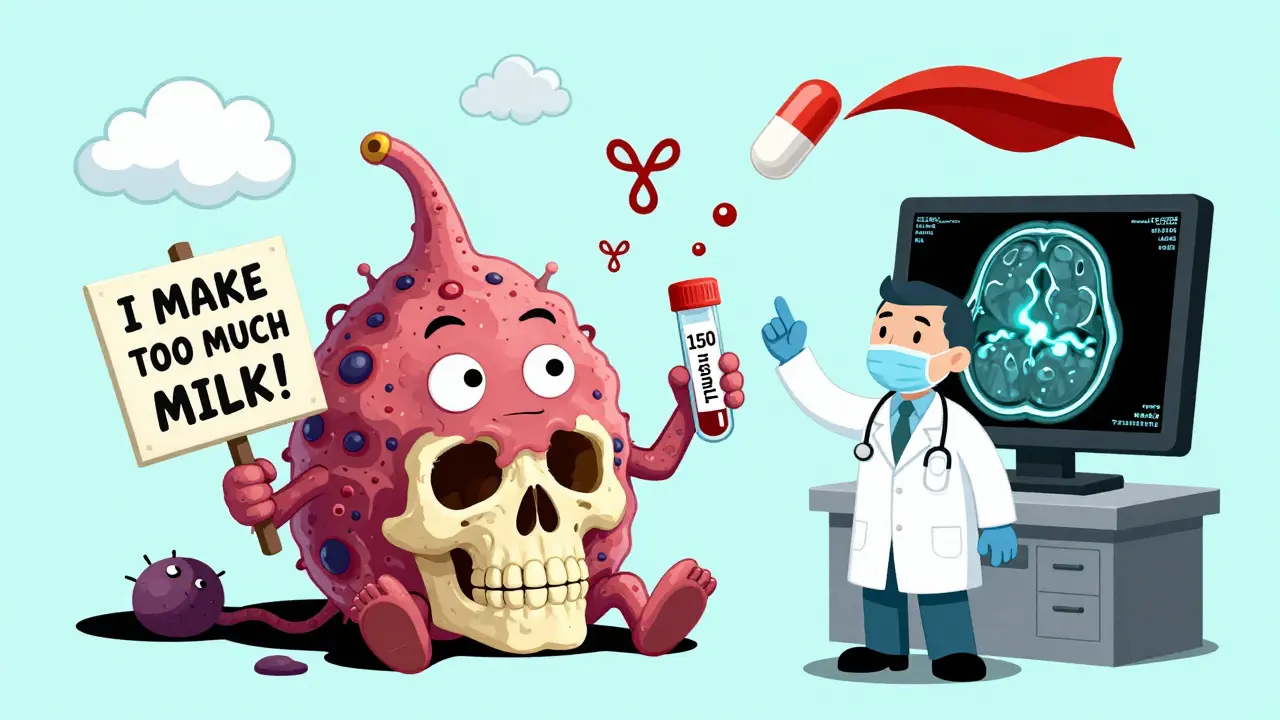
Diagnosis starts with a blood test. If your prolactin level is above 150 ng/mL, there’s a 95% chance it’s a prolactinoma. Levels over 200 ng/mL usually mean the tumor is larger than 1 cm-a macroadenoma. Levels under 100 ng/mL often point to a smaller microadenoma. But it’s not just about the number. A brain MRI with 3mm slices is needed to see the tumor’s size and location. If the tumor is bigger than 1 cm, doctors will also check your vision. That’s because the pituitary sits right under the optic nerves, and a growing tumor can press on them, causing blind spots-especially in your side vision.
Not every high prolactin level means a tumor. Stress, pregnancy, certain medications (like antidepressants or antinausea drugs), and even kidney failure can raise prolactin. That’s why doctors don’t jump to conclusions. They rule out other causes first.
Why Size Matters: Micro vs. Macro
The size of the tumor changes everything. About 80% of pituitary adenomas are microadenomas-smaller than 1 cm. These rarely press on nerves, so vision problems are rare. They’re often found by accident during scans for other reasons. Macroadenomas, bigger than 1 cm, make up the other 20%. These are more likely to cause headaches, vision loss, and pressure on surrounding brain tissue. They’re also harder to treat.
Here’s the catch: even small tumors can produce massive amounts of prolactin. A 5mm tumor might push prolactin to 800 ng/mL. A 2cm tumor might only hit 400 ng/mL. So size doesn’t always match hormone levels. That’s why both the MRI and the blood test are needed.
First-Line Treatment: Dopamine Agonists
The go-to treatment for prolactinomas is medicine, not surgery. Dopamine agonists like cabergoline and bromocriptine trick the tumor into stopping prolactin production. Cabergoline is the winner here. It’s taken just twice a week, has fewer side effects, and works better. Studies show it normalizes prolactin in 80-90% of microadenomas and 70% of macroadenomas within three months.
Most people start with 0.25 mg twice a week. If prolactin doesn’t drop after four weeks, the dose goes up-usually to 0.5 mg or 1 mg twice weekly. It’s slow, but steady. Within 4 to 6 weeks, many patients feel better. A Mayo Clinic case study followed a 34-year-old woman whose prolactin dropped from 5,200 ng/mL to 18 ng/mL in six months. Her tumor shrank by 70% in a year.
Side effects? Nausea and dizziness are common at first, but they fade. Only 18% of patients stop cabergoline because of them. Compare that to bromocriptine-30-40% quit due to severe nausea. That’s why most doctors start with cabergoline unless there’s a reason not to.
When Surgery Becomes Necessary
Surgery isn’t the first option. It’s reserved for people who can’t tolerate medicine, have vision loss, or have tumors that don’t shrink with drugs. The procedure is usually transsphenoidal-meaning the surgeon goes through the nose. Endoscopic techniques now make this minimally invasive. Success rates? Great for small tumors: 85-90% of microadenomas are fully removed. For macroadenomas? Only 50-60% are fully cleared. And even then, recurrence is common-up to 30% within five years.
Immediate risks include CSF leaks (2-5%), temporary diabetes insipidus (5-10%), and rare but serious pituitary apoplexy (1-2%). Many patients report high satisfaction with the procedure-82% on patient forums say they’d do it again. But recovery isn’t quick. You’re in the hospital for 3-5 days, and full healing takes 3-6 weeks.
Radiation: The Slow Option
Radiation is the last resort. It’s used when medicine fails and surgery isn’t safe or didn’t work. It’s not fast. It can take 2-5 years to bring prolactin levels down. But it’s effective long-term: 50-60% of patients reach normal levels after five years.
Gamma Knife radiosurgery delivers a precise, high-dose beam in one session. It’s better than traditional radiation because it’s less likely to damage the optic nerves (only 1-2% risk vs. 5-10%). Still, it comes with a cost: 30-50% of patients develop hypopituitarism-meaning their pituitary stops making other hormones like cortisol or thyroid hormone. That means lifelong replacement therapy.

Long-Term Risks and Monitoring
Treatment doesn’t end when prolactin normalizes. For most people, especially with macroadenomas, you need to keep taking cabergoline for life. Stopping it for even 72 hours can cause prolactin to spike again. About 70% of patients stay on medication indefinitely.
Long-term cabergoline use (over 2.5 mg per week for more than three years) carries a small risk of heart valve problems. The European Society of Endocrinology recommends an echocardiogram every two years if you’re on high doses. The FDA has a black box warning for this reason.
Regular follow-ups are non-negotiable. Prolactin should be checked every three months at first, then yearly if stable. MRI scans are done every 1-2 years, especially if the tumor was large. Vision tests are repeated if there was any compromise.
What’s Next for Treatment?
The future is getting smarter. In 2023, the FDA approved paltusotine for acromegaly, and trials for prolactinomas are already underway. Researchers are exploring gene therapies using CRISPR to target mutations like MEN1, which drive some tumors. AI is being used to plan surgeries with 3D brain mapping, improving precision.
One exciting idea? Dopamine agonist-eluting stents-tiny devices placed in the pituitary during surgery that slowly release medicine right where it’s needed. It’s still experimental, but it could mean fewer pills and better control.
Dr. Maria Fleseriu predicts that within five years, molecular profiling will guide treatment. Instead of treating all prolactinomas the same, doctors will look at the tumor’s genetic fingerprint and pick the best drug or combo. That could push cure rates from 70% to 90%.
What You Need to Do Now
If you’ve been told you have a prolactinoma, here’s what matters most:
- Get your prolactin level and MRI done if you haven’t already.
- Start cabergoline if recommended. Don’t delay-early treatment shrinks tumors and restores fertility.
- Track your symptoms: mood, energy, sex drive, menstrual cycles.
- Don’t stop medication without talking to your endocrinologist.
- Ask about an echocardiogram if you’re on high-dose cabergoline for more than a year.
- See an eye doctor if you have headaches or vision changes.
Pituitary adenomas aren’t emergencies, but they’re serious. Left untreated, they can lead to infertility, osteoporosis, or permanent vision loss. But with the right approach-medication, monitoring, and patience-most people live normal, healthy lives.
Can a prolactinoma go away on its own?
Rarely. Most prolactinomas don’t shrink without treatment. Some very small tumors in women after pregnancy may stabilize, but they rarely disappear. Waiting is risky-prolactin levels can keep rising, leading to bone loss, infertility, or vision damage. Treatment is almost always recommended.
Can I get pregnant if I have a prolactinoma?
Yes, absolutely. In fact, one of the main reasons to treat a prolactinoma is to restore fertility. Once prolactin levels drop back to normal with cabergoline, ovulation usually returns within weeks. Most women conceive within 6-12 months of starting treatment. Doctors often pause medication during pregnancy, but only after confirming the tumor isn’t growing.
Why is cabergoline better than bromocriptine?
Cabergoline works longer in the body, so you take it just twice a week instead of daily. It’s also more effective-normalizing prolactin in 80-90% of cases vs. 70-80% for bromocriptine. Side effects like nausea and dizziness are less common (18% vs. 30-40% discontinuation rates). For these reasons, cabergoline is now the first-choice drug in all major guidelines.
Do I need to take medicine forever?
For most people with macroadenomas, yes. Even if the tumor shrinks and prolactin normalizes, stopping medication leads to rebound in over 70% of cases. Some people with small microadenomas may be able to stop after 2-3 years of stable levels, but only under strict supervision. Never stop on your own.
What are the signs that my prolactinoma is getting worse?
Watch for worsening headaches, new vision problems (especially loss of side vision), nausea, or sudden fatigue. If you’re a woman, return of irregular periods or milk production after treatment stopped. For men, worsening erectile dysfunction or low energy. These could mean the tumor is growing again. Contact your doctor immediately if you notice these.



Amisha Patel
I never realized how much one tiny gland could mess up your whole life. I had unexplained fatigue and irregular periods for years before my doctor mentioned prolactinoma. Took me forever to get tested, but once I started cabergoline, everything changed. My energy came back, and I’m trying to conceive now. So grateful I didn’t ignore it.